Diagnostic Medicine/Pathobiology
Clinical Pathology
Residency Training Program
Program Mission
The Residency in Veterinary Clinical Pathology at the Kansas Veterinary Diagnostic Laboratory (KVDL) is a three-year, post-DVM training program designed for veterinarians with a strong interest in veterinary clinical pathology and aims to train them into well-rounded clinical pathologists. During the training, the residents will be exposed to K-State's unique strength of exotic animal specimens and will have the opportunity to investigate interesting cases or conduct research projects that lead to publication. During the training, the residents will be prepared for the American College of Veterinary Pathologists (ACVP) Phase I Board exam. Upon finishing the training, the residents will be eligible for the American College of Veterinary Pathologists (ACVP) Phase II Board exam. The program emphasizes hands-on experience, progressive responsibility, and exposure to a wide range of diagnostic disciplines.
For Information Contact:
Dr. Alan Yu, Residency Coordinator
Clinical Pathology
785-532-4627
Email
Program Organization
The residency is primarily supervised by board-certified clinical pathologists, with additional support from faculty within the Department of Diagnostic Medicine/Pathobiology. This structure ensures consistent mentorship while providing access to a broad range of expertise across disciplines.
The Kansas Veterinary Diagnostic Laboratory (KVDL) offers a comprehensive, full-service diagnostic environment with multiple specialized sections. Residents have access to a wide spectrum of diagnostic services and resources (see laboratory overview), supporting both routine case work and advanced diagnostic investigations.
Through close collaboration with faculty and diagnosticians across these services, residents can gain valuable experience integrating clinical pathology findings with other diagnostic methodologies. This interdisciplinary approach enhances clinical reasoning and supports the development of complex case investigations, as well as scholarly projects that leverage diverse areas of expertise.
The program also benefits from strong partnerships between KVDL, state agencies and Kansas State University–affiliated institutions (additional information), which broaden case exposure and provide unique opportunities to engage with cases of regional and regulatory importance, further enriching the training experience.
Program Structure and Schedule
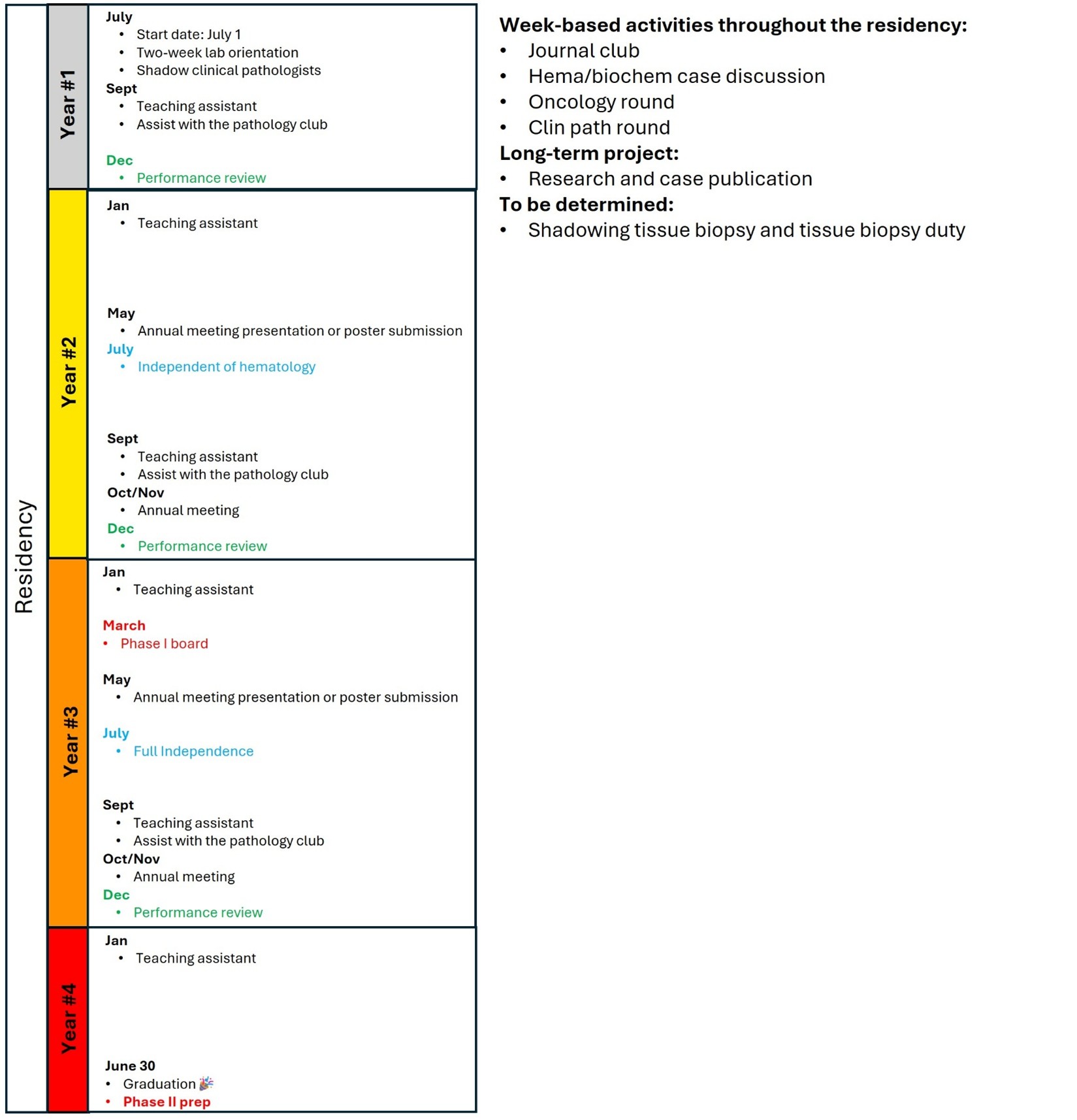
The residency is designed to support progressive, year-based independence within a collaborative and well-supervised environment. Residents benefit from protected time for education, structured experiential learning, and abundant opportunities for self-directed professional development.
A detailed timeline (see figure) highlights key milestones and illustrates the program’s intentional progression from foundational training to full diagnostic autonomy and board preparation/certification.
Teaching
Orientation
The program begins with a comprehensive two-week onboarding experience, during which residents receive intensive, one-on-one instruction from experienced medical technologists and laboratory technicians. This immersive introduction provides opportunities to:
-
Gain hands-on experience with clinical pathology analyzers, which covers basic concepts about troubleshooting and SOPs.
-
Develop technical proficiency in preparing diverse specimen types, including hematology samples, crossmatches, fine-needle aspirates (FNA), body fluids, respiratory washes/lavages, and bone marrow specimens
This early training is designed to equip residents with a strong foundation in laboratory workflow, testing methodologies, quality assurance/quality control (QA/QC), and analytical concepts, such as pre-analytical and analytical errors, artifacts, and interference.
During the first three months of training, residents also have access to an extensive teaching set of hematology slides along with fresh cerebrospinal fluid and urine samples, providing rich opportunities to accelerate diagnostic skill development and build analytical confidence early in training.
Diagnostic training
Diagnostic training is a central strength of the program, offering a highly supportive, hands-on learning environment with progressive responsibility tailored to individual development.
Residents initially work closely with clinical pathologists, gaining insight into case interpretation and clinical decision-making. As their skills develop, they are given increasing opportunities to independently evaluate cases and formulate diagnostic reports, with faculty providing timely feedback and mentorship.
The structure of the program allows residents to achieve early confidence in hematology interpretation and to progress toward full diagnostic autonomy across service areas. Throughout this process, faculty remain readily available for consultation, ensuring both a strong educational experience and high-quality patient care.
We seek proactive residents with high self-motivation because the program fosters a culture of self-directed learning, encouraging residents to take advantage of diverse institutional and laboratory resources. Faculty serve as mentors and guides, supporting the development of critical thinking and lifelong learning skills essential for success in clinical pathology.
Through an open-door policy, the clinical pathology laboratory also promotes active communication with clinicians and clients across multiple disciplines to discuss case interpretation and differential diagnoses. These interactions provide valuable opportunities for residents to refine their communication skills and clinical reasoning, supporting their development into well-rounded clinical pathologists prepared for careers in academia, diagnostic service, or industry.
Teaching
Residents are offered meaningful and progressive teaching opportunities throughout the program, allowing them to develop as effective educators and communicators. Residents participate in the instruction of veterinary students alongside Dr. Lisa Pohlman, contributing to courses such as DMP 811 Clinical Pathology I and VDMP 835 Clinical Pathology II.
-
Residents also share teaching responsibilities with clinical pathologists to lead slide sessions and clinical pathology case discussions towards rotating veterinary students, reinforcing both diagnostic reasoning and teaching skills.
-
After achieving partial or full autonomy, senior residents take on mentorship roles by providing case-based teaching to visiting students, interns, and house officers.
-
Toward the end of the residency, senior residents will experience a faculty member’s role by offering feedback on junior residents’ case write-ups.
These layered experiences support the development of strong teaching skills, preparing graduates for careers in academia, diagnostic service, or industry.
Research and Scholarly Activity
Residents are strongly encouraged and well-supported in pursuing a wide range of scholarly activities, such as publishing case reports, contributing to research projects, and presenting diagnostic findings at regional and national professional meetings. These experiences are designed to foster academic development, scientific communication skills, and professional visibility.
Each year, residents are expected to present their work as platform or poster presentations at meetings including but not limited to:
-
American College of Veterinary Pathologists Annual Meeting
-
Southeastern Veterinary Pathology Conference
-
Midwest Association of Veterinary Pathologists Annual Meeting
To support these activities, funding for travel associated with approved scholarly work is provided by the Kansas Veterinary Diagnostic Laboratory (KVDL), in accordance with institutional policies.
Resources & infrastructure
Recent case volumes requiring pathology review average 13.4 cytology and 5.1 hematology cases per day. A distinctive strength of K-State is its robust exotic animal service with recent records indicating that approximately 9.8% of submitted specimens originate from exotic species. Applicants with a particular interest in exotic animal clinical pathology are therefore strongly encouraged to apply.
The K-State Clinical Pathology Laboratory offers a broad range of diagnostic tests and analyses. In addition to routine hematology and serum biochemistry, the laboratory performs specialized assays, including ferritin measurement in various wildlife species, total T4 and cortisol testing, and serum protein electrophoresis. The laboratory also collaborates with veterinary clinical pathology laboratories across the United States on select cases requiring advanced or specialized evaluation. Residents receive comprehensive, well-rounded training at K-State, encompassing both routine diagnostics and specialized testing.
Application Deadline
Oct. 1, 2026
Start date: July 1, 2027
Contact person
For more information about the program, please contact Dr. Alan Yu (email).
Compensation and benefits
Residents are eligible for standard university employee health benefits. For more information regarding the benefits, please visit K-State Human Resources: Benefits.
Former and Current Trainees and Career Trajectories
-
Mikkela Cabanillas, DVM— Clinical Pathology Resident, University of Florida
-
Irene Dobles, DVM— Clinical Pathology Resident, University of Georgia
-
Tatiana Paz, DVM, PhD— Anatomic Pathology Resident, Kansas State University
-
Ryan Davila, DVM—Diagnostic Clinical Pathologist, Eastern VetPath