Peying Fong
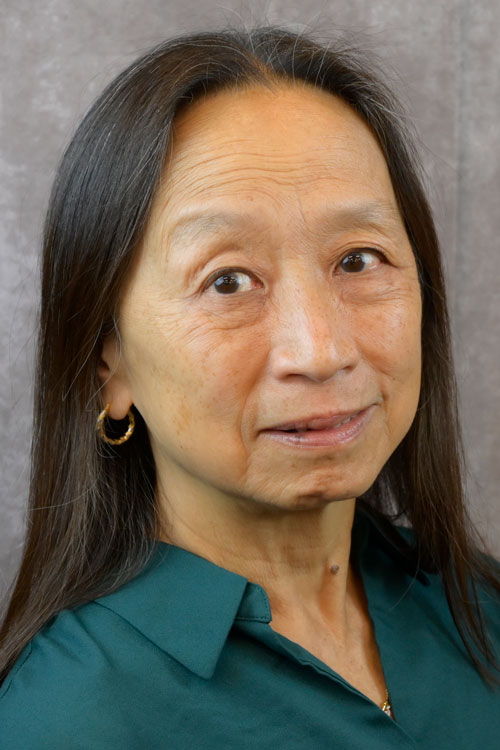
Professor of Physiology
BS, Biology, Yale University
PhD, Physiology, University of California, San Francisco
Office: Coles Hall 212
Phone: 785-532-4524
Email
Research Interests
Peying Fong’s research interests and the focus of her lab center on understanding the structure and function of proteins that facilitate salt, solute, and water movement across intracellular and plasma membranes. Transport processes enable by these channel and transporter proteins underpin functions critical to all systems within the body. This is underscored by the plethora of diseases that can ensue when they do not function properly.
In addition to being a graduate faculty member in Anatomy and Physiology, Dr. Fong is a member of the Biochemistry and Molecular Biophysics Graduate Group, and The Johnson Cancer Research Center. She is a Senior Editor and serves on the Editorial Board of the Journal of Physiology, and she is a Fellow of The Physiological Society.
Professional Societies
- The Biophysical Society
- The Society of General Physiologists
- The Physiological Society
- The American Physiological Society
Teaching
Dr. Fong teaches the Digestive Physiology block of Systems Physiology II (VAP 817) in the first-year veterinary curriculum. Her didactic teaching extends to instruction in Renal and Gastrointestinal Physiology in AP 717 of the One-Year Master's Curriculum. She also offers AP 828: Electricity in Biological Systems, to introduce graduate students to this important dimension of physiology.
Berg, R.G.M., Hamilton, K., Murray, J.F., Fong, P. (2024) Editorial Peer review: the imprimatur of scientific publication. Simultaneously co-published ǂ in J. Physiol. Sep;602(17):4079-4083. doi: 10.1113/JP286273 and Exp. Physiol. Sep;109(9):1407-1411. doi: 10.1113/EP092108.
ǂ The Journal of Physiology and Experimental Physiology both are published by The Physiological Society. The pieces differ only in adjustments in formatting to meet requirements of these journals. Content is identical and either piece can be referenced.
Basel, M.T., Malreddy, P., Schultz, B., Fong, P., Coetzee, J.F., Rush, B.R. (2024) Spotlight Preparing students to apply to and succeed in medical professional schools. J. Am. Vet. Med. Assoc. Sep 1;262(9):1269. doi: 10.2460/javma.24.05.0320.
Coppola, MA, Gavazzo, P, Zanardi, I, Tettey-Matey, A, Liantonio, A, Fong, P, and Pusch, M. 2023. Distinct ClC-6 and ClC-7 Cl- sensitivities support ClC-7’s role in lysosomal Cl- homeostasis. J. Physiol. 601 (24): 5635-5653. doi.org/10.1113/JP285431
Fong, P. (2023) Invited Chapter Evaluating Integrity of Cultured Pig Thyroid Follicular Epithelia. In: Epithelial Cell Culture: Methods and Protocols, Baratta, M., Ed. from Methods in Molecular Biology series, volume 2749: 7-23. Humana Press, Springer Science + Business Media, LLC, Springer Nature, New York.
Mansley, M.K. and Fong, P. (2023) Editorial Ion channels and transporters keep ideas flowing J. Physiol. 601 (9): 1517-1519. https://doi.org/10.1113/JP284654
Zifarelli, G, Pusch, M, and Fong, P. 2022. Altered voltage-dependence of slowly activating chloride-proton antiport by late endosomal ClC-6 explains distinct neurological disorders. J. Physiol. 600 (9): 2147-2164.
*This paper was the subject of a Perspectives article: Kobertz, W.R.2022. Want to hear ClC-6 sing? Push your amp to eleven. J. Physiol. 600 (9): 2019-2020. doi.org/10.1113/JP283060
Fong, P. (2021) Perspectives SARS-CoV-2: pushing the E(nvelope) J. Physiol. 599: 2785-2786. https://doi.org/10.1113/JP281601