When Learning Comes on Four Paws
A special partnership creates unexpected learning opportunities.
Story by Wendy Barnes
Photo caption top: Veterinary students pictured with each of their service dogs in training. From left to right: Ally Hazy and Gordo; Kylie Bitcon and Cork; Ray Riggenbach and Fox; Jess Mayer with Orchid and Ramey. Photo by K-State Photo Services.
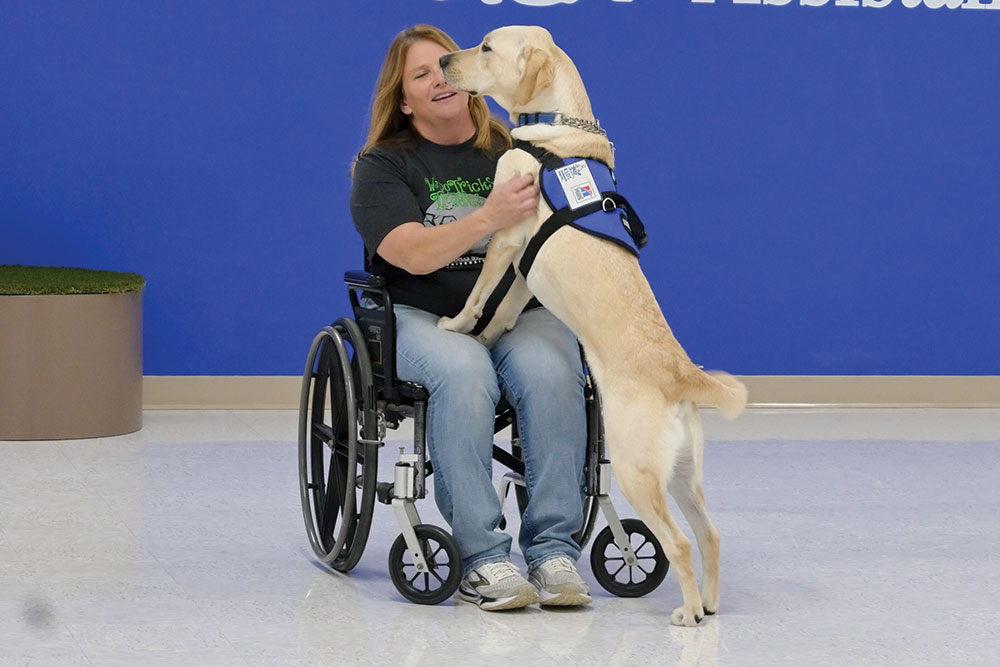
On any given day in the College of Veterinary Medicine complex, it is not unusual to see students, faculty or staff pause to pet or cuddle a dog in the hallway, library or business office. For many, these moments offer a brief break in a demanding day. For a select group of veterinary students, however, those dogs represent something more — a responsibility, a learning experience and, eventually, a difficult goodbye.
Veterinary students raise the next generation of service dogs
For Kansas State University veterinary students, the path to becoming a Doctor of Veterinary Medicine is demanding, filled with long days and heavy coursework. For some students, that journey now includes an unexpected companion: a KSDS dog-in-training quietly curled at their feet during lectures, labs and late-night study sessions.
Through a partnership between KSDS, located in Washington, Kansas, and the College of Veterinary Medicine, students take on the role of handlers, raising and training future service dogs while navigating veterinary school. The experience challenges them, connects them to one another and gives purpose to moments both inside and outside the classroom.
Pandemic brainchild
The idea for the program began during the COVID-19 pandemic, when former Dean Dr. Bonnie Rush explored wellness initiatives to support students facing unprecedented stress. Building on the college’s long-standing relationship with KSDS, she proposed bringing dogs into the classroom — not as pets, but as trainees with a mission.
Working alongside Annette Kohlmeyer, breeding coordinator at KSDS, the college encourages students to apply for the program. Kohlmeyer then screens applicants to determine which students are best suited to receive a dog.
“We’re looking for a little bit of what their background is,” she says. “Do they have a fenced-in yard? Do they have some experience in animal behavior? So, we will call and check that kind of stuff, just to see which would be the better ones.”
KSDS encourages students who are not selected for a dog to work together as a team. While one student serves as the primary handler, others can act as secondary trainers, helping share the responsibility and reduce stress.
What began as a wellness idea quickly became part of daily life. Today, Ksds dogs are a familiar presence in lecture halls — quiet, focused and rarely disruptive. “All of the professors, I think since they’ve dealt with dogs since Snyder, they’re all very familiar with the dogs in the classroom,” says Kylie Bitcon, class of 2028, who raised Cork. “If a dog is snoring during class or lets out a small whine or a bark, it doesn’t faze them at all.”
A responsibility that shapes the student
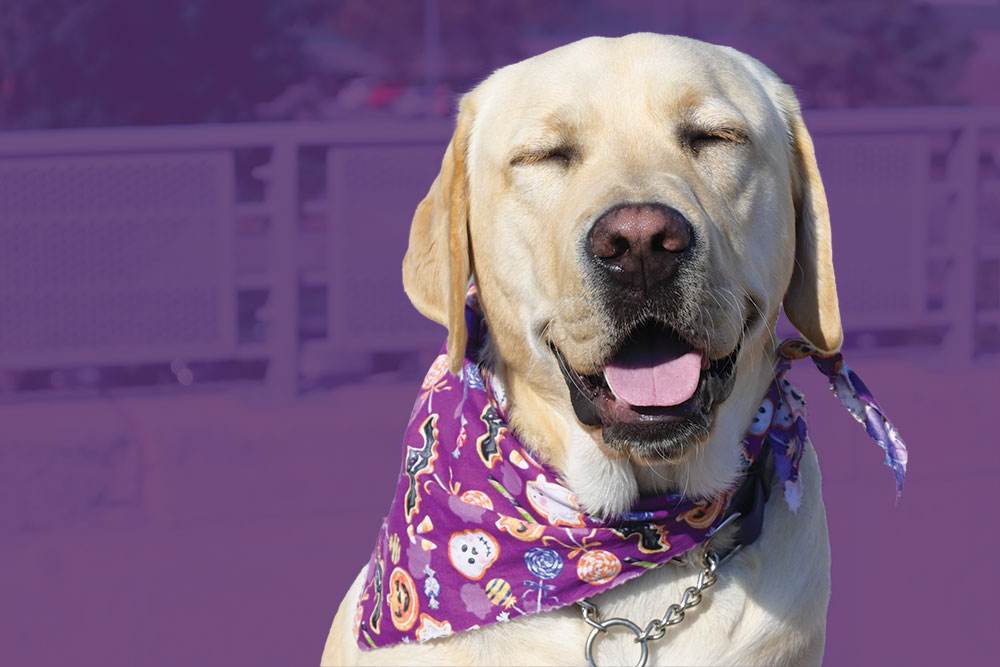
Becoming a KSDS handler is not a casual commitment. Students commit to 18 months of training, socialization and reporting. Over that time, handlers teach their dogs 30 commands, reinforce appropriate public behavior and help them remain calm and focused while wearing their service vests.
Despite the added responsibility, students consistently say the dogs help them manage stress rather than add to it.
Ray Riggenbach, class of 2029, applied after watching a documentary about a student handler and realizing the impact one person could have on another’s life.
“I feel very lucky,” she says of raising Fox. “She’s a very, very good puppy. I’ve raised puppies before, and she’s by far the calmest and most well-behaved one I’ve ever had.”
For Ray, Fox provides grounding and motivation during demanding days.
“She doesn’t make anything harder,” Riggenbach says. “She actually makes it better.”
For Madison Latham, class of 2026, the journey began during first-year orientation, when images of KSDS dogs appeared on screen.
“My roommate, Jamie Williams, and I just looked at each other and knew,” Latham says. “We wanted one.”
They were the only students from their class who showed up to receive a dog — and that dog was Snyder.
Snyder attended classes with Madison, learning how to behave in public spaces. Training continued at home, often replacing mealtimes.
“For dinner, instead of just feeding him, we’d train,” she says. “Kibble by kibble, working on commands.”
As Snyder progressed, Madison’s understanding of patience, structure and responsibility deepened.
“I learned so much — not just about training a dog, but about responsibility and priorities,” she continues.
Ally Hazy, class of 2027 is Gordo’s handler and previously trained McFly, explains that McFly and Gordo’s presence in her life has helped her get through vet school.
“I feel like he (McFly) is part of the reason I’ve been able to do everything that I’ve done because he helped settle a lot of things; now Gordo does the same thing,” she says. “I can be having a bad day, but then these kiddos come out and they just make everything better.”
Learning together: students and dogs
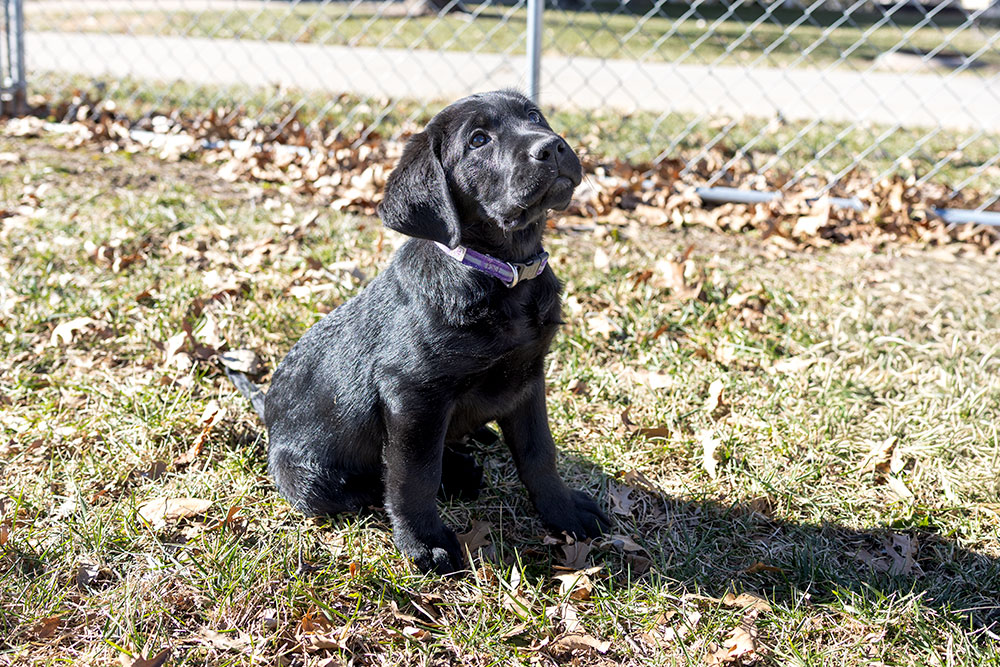
Training does not happen in isolation. Posters listing the 30 required commands hang throughout the college, and classmates, faculty and staff help reinforce consistent behavior. At the same time, students learn to advocate for their dogs’ training needs — especially when the dogs are working.
“If she has her vest on, people are supposed to ignore her,” Riggenbach explains. “No petting, no talking. She needs to know she’s working, not playing.”
Kylie’s experience differed slightly. Cork was already seven months old when she received him, shifting her focus from basic commands to socialization.
“Bringing him to school every day was huge,” Bitcon says. “They learn how to chill during lectures. I honestly think the dogs learn just as much as we do here.”
Through the program, Kylie also gained a deeper understanding of what service dogs provide to people with disabilities.
“Getting to talk with some of the graduates and hear about the different things the dogs can do for them, like tugging off their coat or helping them pull off their shoes,” she says. “Things that we can do and don’t even think twice about.”
The hardest — and best part
From the start, handlers know their time with the dogs is temporary. Still, saying goodbye after 18 months is never easy.
“She’s not just leaving me to be a pet somewhere else,” Ray says, thinking ahead to Fox’s future. “She’s going to change someone’s life. She’s going to do something important.”
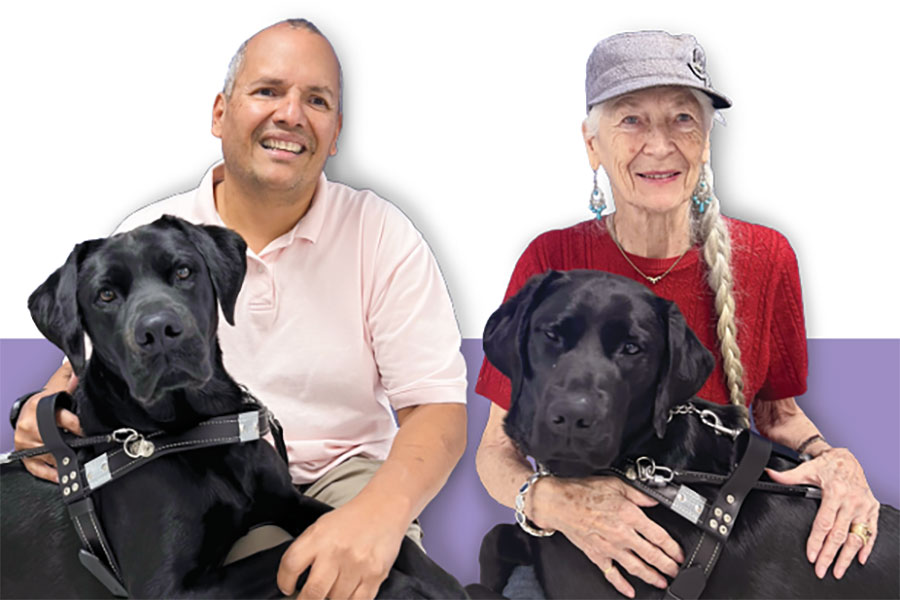
For Madison, meeting Snyder’s new partner, Miquel Hernandez Sanchez, made letting go easier.
“He’s in such an amazing home,” she says. “It filled my whole heart with joy. He’s living his best life.”
Kylie admits her biggest concern was whether she had done enough for Cork and how the transition might affect him.
“We’ve spent the last year and a half with those dogs and then luckily at the turn-in process they do make it a quick goodbye; which is kind of sad, but I think it’s easier on everybody,” she says.
The other three dogs who have left the halls of the college, Ohlde, McFly and Cork, have moved on to their next chapters. Ohlde now assists Vivian Lane in Paris, Arkansas, McFly works as a facility dog and Cork continues training as a service dog, with an anticipated graduation in April 2026.
Looking ahead
As new students step into the role of handlers, the program continues to shape future service dogs and future veterinarians.
Kohlmeyer says working with the students has been rewarding.
“The girls did a great job raising them (Ohlde and Snyder),” she says. “They were fun to come back and work with.”
Kylie welcomed her new KSDS dog, Ace, in early January. Ray, still early on her journey with Fox, is already looking ahead.
“The first one always makes me want another, and then the second one is a terror most of the time,” Ray laughs. “But I’d do it again in a heartbeat.”
For these students, raising a service dog is not just an addition to their education — it is an experience that teaches empathy, resilience and the true meaning of service.