Over the Hump
Local field trips remove any drama from dromedary medicine.
Story by Joe Montgomery, photos by Jennifer Bailey, Memories by Jen Bailey (Except as noted)
Photo caption top: Valeri introduces Sadri the camel to students during one of the recent field trips.
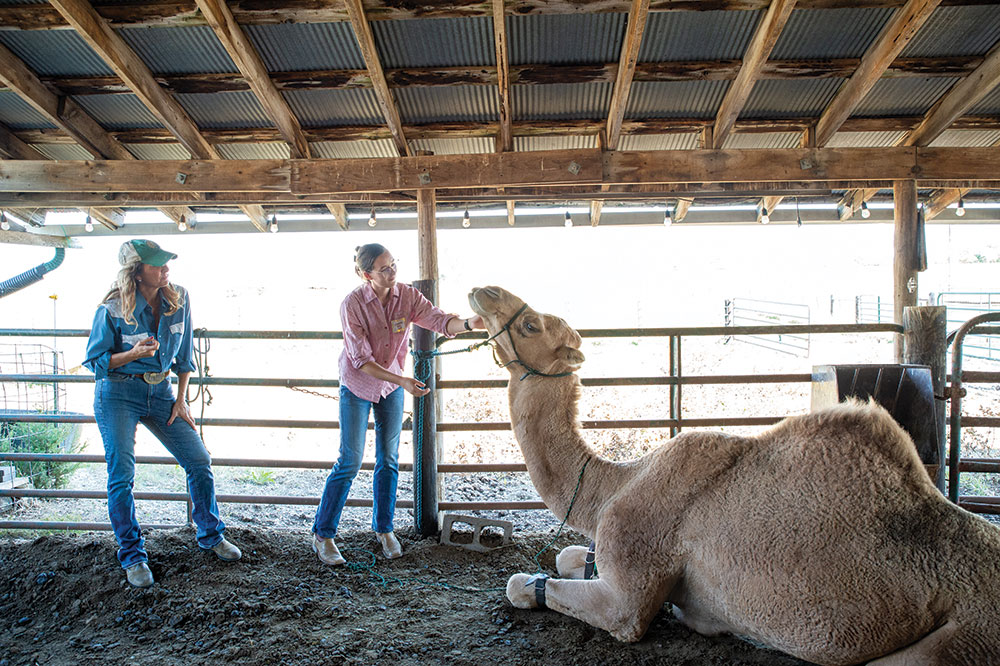
Yes, there are camels in Kansas. There happen to be five such cherished dromedary residents at Shamrock Farms, located just east of Manhattan in the Flint Hills. The farm’s proximity to K-State provides a unique and excellent learning opportunity for veterinary students.
“K-State has been a lifeline for my camel herd for 20 years and I am so grateful for this,” says Valeri Crenshaw, the manager of Shamrock Farms.
A model opportunity
"The service I have received from KSU veterinarians has also been greatly envied by other camel owners within North America,” she says proudly. “Our partnership of providing workshops for K-State veterinary students has highlighted KSU as a pioneer among other veterinary schools.”
Dr. Leslie Weaver, clinical assistant professor of livestock services, says visiting the camels gives students both a real-world and a worldly experience in the field. “Valeri is very passionate about teaching our students how to work with camels in hopes that more veterinarians will feel comfortable working on them in practice,” Dr. Weaver says. “She is an incredible voice for North American camel owners and has been a great resource to my husband Bryan [who is also a clinical assistant professor in livestock services] and I for working with camels.”
Valeri says other veterinary colleges need to follow the K-State example.
“This progressive approach by the veterinary school has allowed us to literally say to other universities, ‘Look, K-State has been doing this for 10 years and you need to get on board for the sake of your students and our camels,’” Valeri says.
Camel care 101
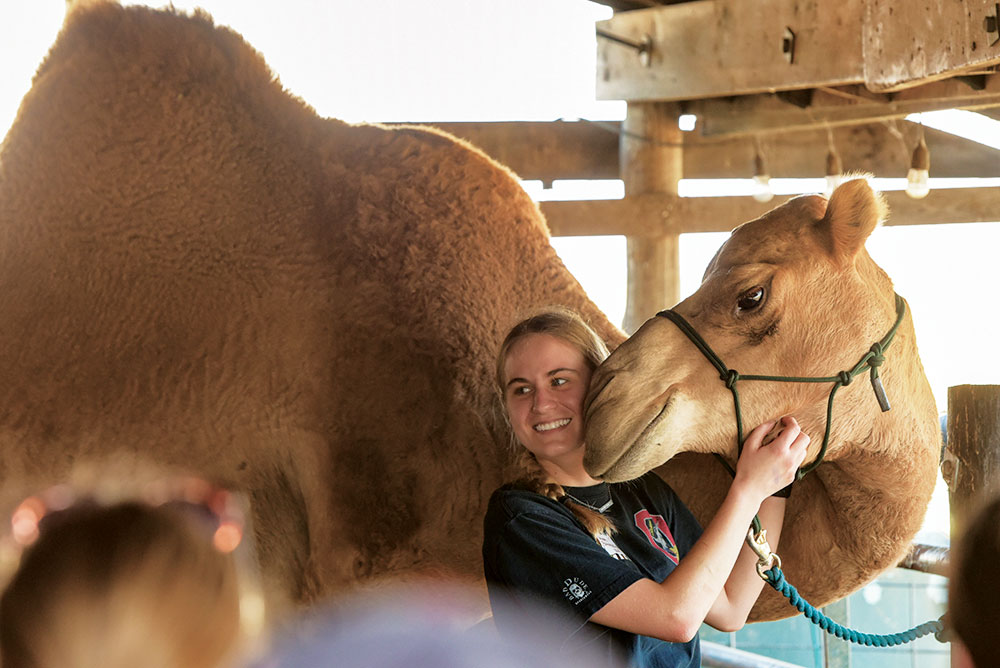
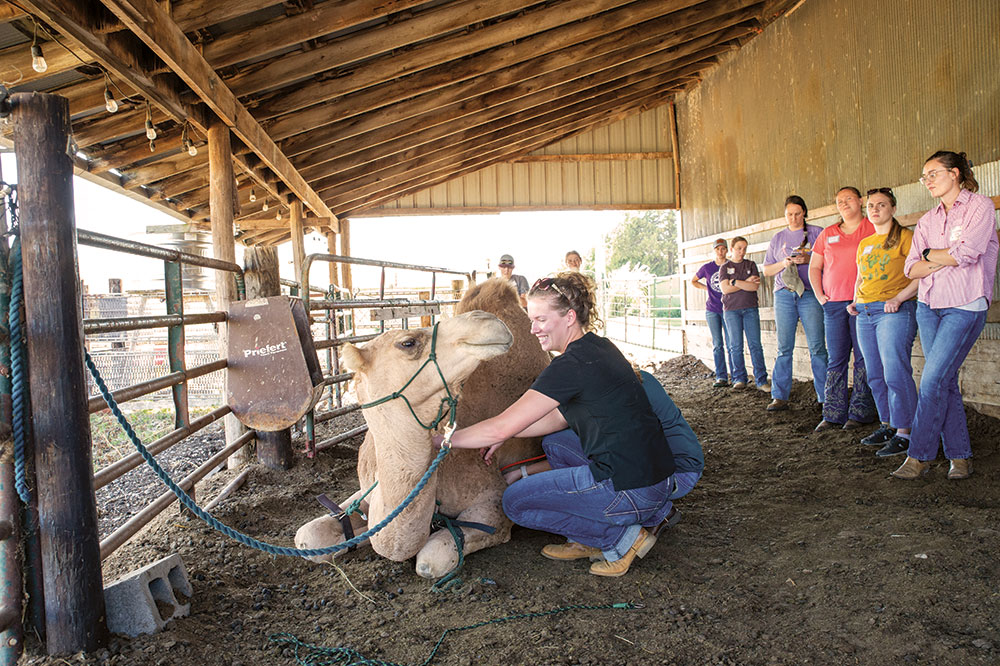
Dr. Weaver says her team provides regular herd health appointments to do annual physical exams and give vaccinations. “When I take students out there, my goal is for them to get exposed to some of the common camel restraint techniques,” Dr. Weaver says. “Valeri’s camels are all very well trained, so we can talk about couching on command [helping the camels to lie down comfortably] and using various hobble techniques
for either cush or standing procedures.”
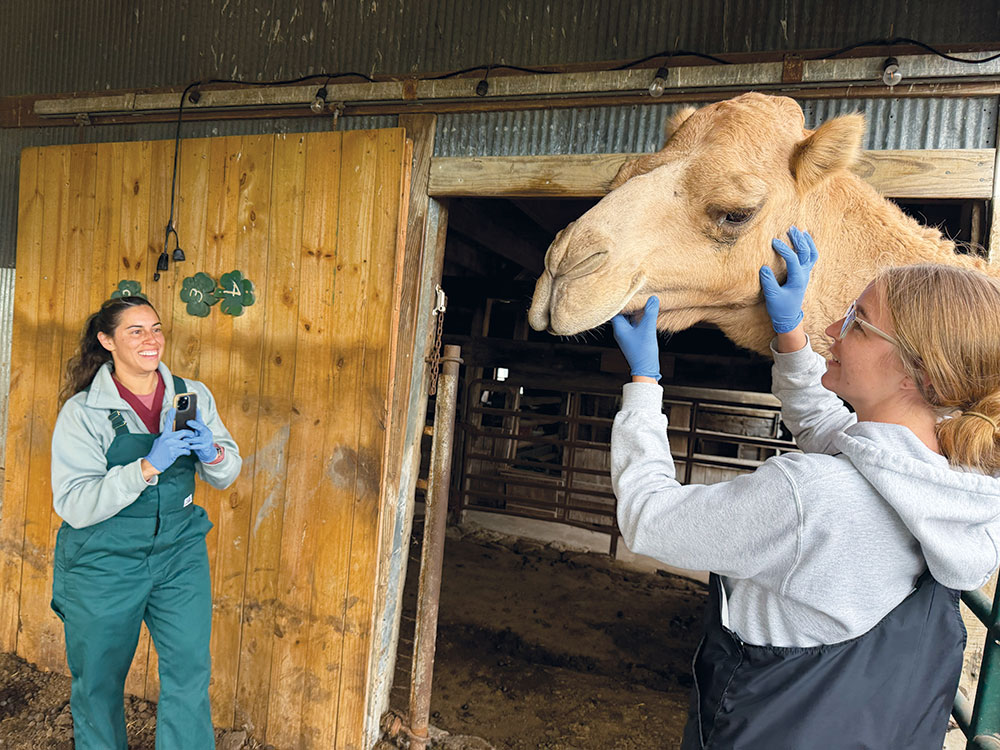
“Shamrock Farms offered us a unique opportunity to practice physical exams and blood draws on camels, a species you don’t often encounter but could easily see in mixed animal practice,” says fourth-year student Tessa Flournoy. “I was impressed by how well-trained and safe the camels were to work with, and by Valeri’s generosity in teaching us about camel handling and husbandry. The experience highlighted the variety you can encounter in veterinary medicine and reinforced the importance of being prepared for any type.”
While these visits are generally conducted through livestock field services, the exotics service has occasionally consulted at the farm and with zoo animals, particularly when there are in-house camel cases.
“Our last camel workshop at Shamrock Farms [in October 2025] included 35 KSU veterinary students,” Valeri says. “We always make it a point to talk about how to approach the camel, how to interact with the camel, how to respond to the camel’s stress and how to soothe a camel. The K-State students at this workshop jumped right in and used their new skills to provide good bedside manner to Sadri [one of the camels] and
he seemed to eat it up. That’s a great sign!"
Camels in Cattle Country
“Our story begins with a deep-rooted legacy in cattle farming, where we have always been passionate about raising registered Angus cattle on our expansive 1,000-acre ranch,” says Valeri Crenshaw, manager of Shamrock Farms near Manhattan. “Raising camels in the midst of cattle country was a challenge, with limited resources and guidance available in the United States. We relied heavily on the expertise of a local university’s veterinary school, learning about camel care, feeding and health needs.” Valeri says camel farms are relatively rare in the United States.
“Despite the large size of our country, the numbers of camels remain relatively small,” Valeri says. “We estimate there are around 7,000 to 8,000 camels in the U.S.”
There are several types of typical camel farms in America. Valeri says the types of farms include camel milk dairies, breeding producers and tourism destinations.
“Many camel farms are multispecies farms that have a small number of camels but a large range of animals that are considered exotics,” Valeri says. “Some of the exotic-animal farms are designed for tourism or family entertainment such as petting zoos or places to conduct parties, children’s educational programs or holiday events.”
Unlike cattle farms as mentioned earlier, camels are generally not raised as a source of food.
“We don’t have the numbers yet for camels to be used for meat production in the U.S.,” Valeri says. “We have
immigrant populations that seek camel meat, just as they seek camel milk. But due to the cost of camels, the small population in the U.S. and some cultural norms, camel meat production is not common in the U.S. and thus is typically imported from other countries.”
Valeri says one of the reasons they have camels at Shamrock Farms the two species of camel and cattle complement each other’s grazing practices.
“The camels are naturally attracted to the invasive plants that ranchers do not want in the prairie and the cattle do not want to eat,” Valeri says. “Camels will eat those plants other livestock won’t, such as locust trees, Buckbrush, Serecia Lespedeza, musk thistle and Dog Wood. The Shamrock Farms camels are part
of our plan to maintain the tallgrass prairie.”
Just like with other livestock owners, camel owners in North America can be part of the North American Camel Ranch Owners Association, or NACROA.
“This livestock association works to support the camel industry, promote camel products, advocate for camels and provide education for industry stakeholders and the public,” Valeri says. She serves as the secretary general for NACROA. “I am so impressed with how our community comes together to work toward the highest industry standards and welfare for our camels.”
Valeri says one of the most beneficial programs NACROA has is its drive to engage universities and veterinary students.
“By collaborating with these institutions and their students, and by providing educational programs about camels, we are paving the way for improved care for our current camel herds and future camel herds in North America,” Valeri says. “The students always ask thought-provoking questions, interact confidently with the camels and give all the camel owners hope the next class of veterinarians will be even more equipped to handle our beloved animals. Cheers to these students and their professors for sharing their class time with us."