Double Duty
Military veterinarians provide critical care during international deployments.
By Joe Montgomery
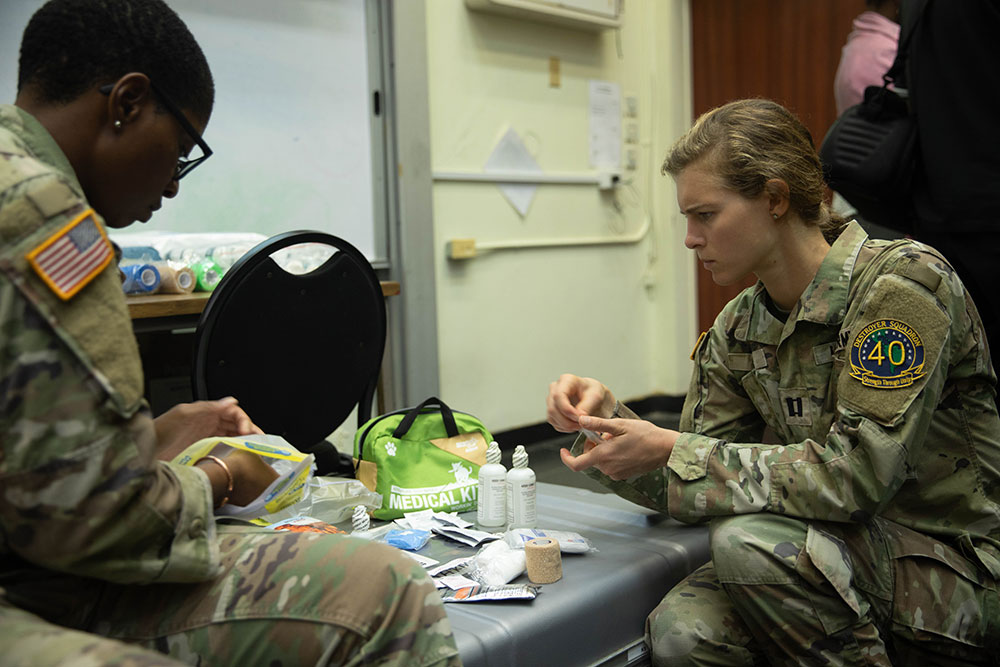
Photo caption top: Capts. Levi Jackson and Chalise Brown conduct clinical side-by-side trainings' with veterinary personnel at the Koror State Animal Shelter in Palau. Photo by Mass Communication Specialist 2nd Class Jordan Jennings, US Navy.
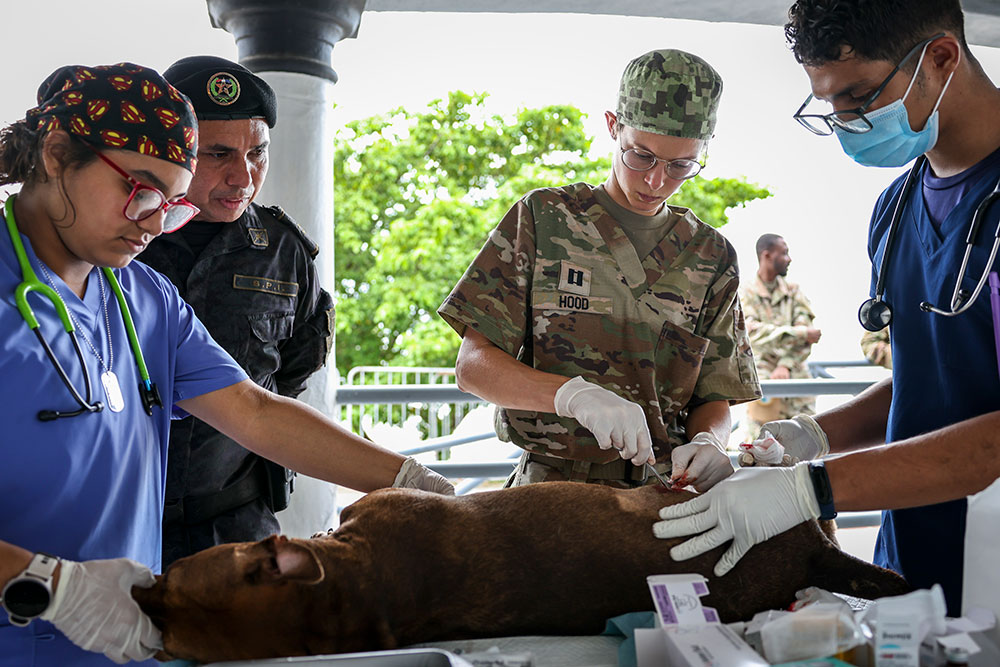
Two veterinarians and classmates from the K-State DVM class of 2023 recently experienced similar opportunities to get out of their normal routines. Drs. Levi Jackson and Karen Hood, are both now serving as veterinarians and officers in the U.S. Army Veterinary Corps. During the summer of 2025, the pair were both deployed with the U.S. Navy on two different overseas missions.
Capt. Hood deployed on Continuing Promise 2025 and Capt. Jackson deployed with Pacific Partnership 2025.
“We both served as the mission veterinarian for our respective missions, leading events in animal medicine,
surgical operations, agricultural training, food safety and veterinary public health across several countries in the Pacific Ocean [Pacific Partnership] and the Caribbean Sea [Continuing Promise],” Capt. Jackson says. “Both of these missions are focused on building capabilities in the local populations, preparing these countries for independence and readiness for response to disasters.”
Taking their skills around the world
Capt. Jackson says the veterinary teams utilized their unique skill sets to make lasting impacts and build connections from individual farmers and families to the heads of state and national leaders.
“We are increasing the safety and security throughout the region, and allowing for shared expertise across 14 separate countries,” says Capt. Jackson, who is originally from San Angelo, Texas. His current unit is the 72nd Medical Detachment, Veterinary Service Support (MDVSS), at Fort Campbell, Kentucky, so this ocean-going mission provided a novel experience.
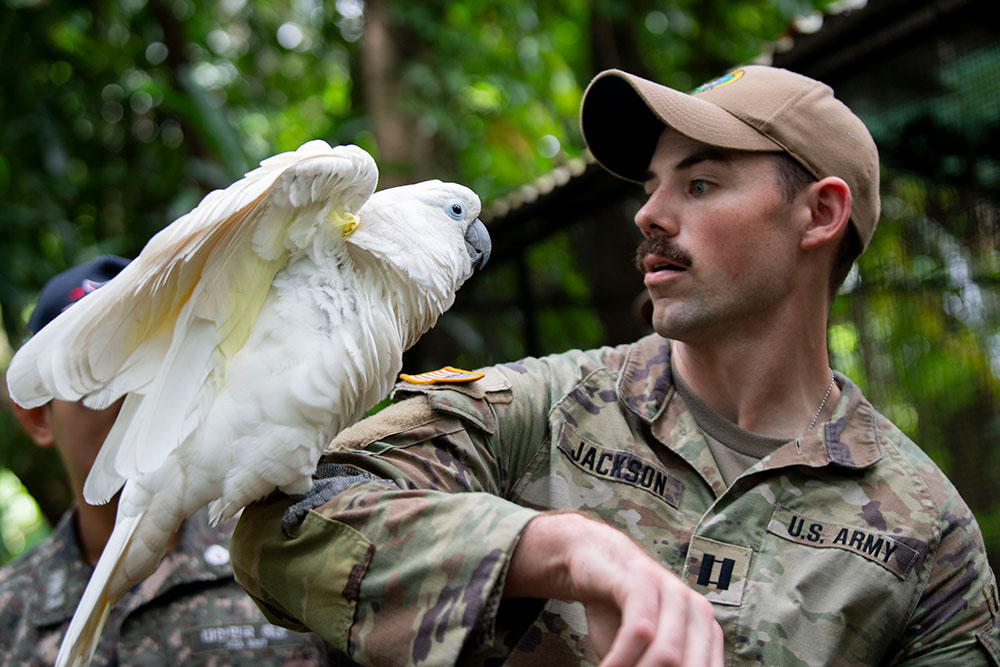
Capt. Jackson explains that the Pacific Partnership was the 21st iteration of the largest annual multinational humanitarian assistance and disaster management preparedness mission conducted in the Indo-Pacifi c. He and the rest of the team deployed to places such as Fiji, Chuuk, Palau, Papua New Guinea, Pohnpei, Samoa, Tonga and Vanuatu. The mission worked with military partners from Australia, Canada, France, Germany, Japan, Malaysia, New Zealand, Singapore, South Korea and the United Kingdom.
Capt. Hood hails from Sterling, Virginia, and is stationed with the 248th Medical Detachment, Veterinary Service Support (MDVSS), at Fort Bragg, North Carolina.
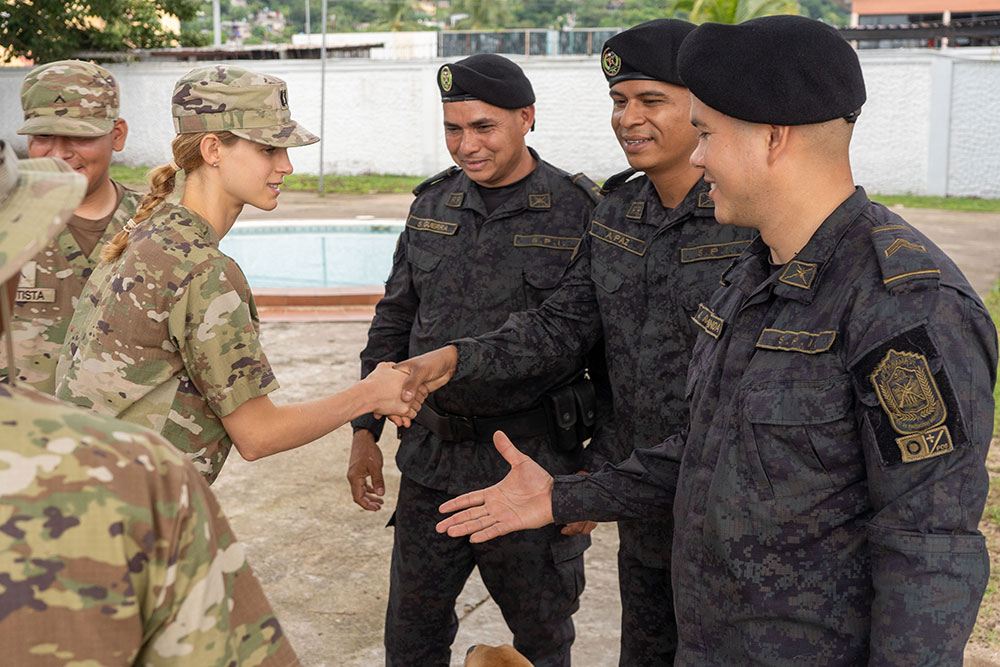
She served with the Continuing Promise team, which deployed to Costa Rica, Dominican Republic, Ecuador, Grenada, Panama and Trinidad. Capt. Hood led her team in discussions and trainings with local farmers, local and national government agencies and non-governmental organizations, covering issues in the cattle ranching industry, gaps in ruminant veterinary care in rural areas and learning from the locally experienced veterinarians for how they practice austere (or resource-limited) medicine.
“We were able to work with some of the same veterinary teams as previous Continuing Promise missions, so that continuity of US-local relations was nice and provided an easier introduction for this year’s team,” Capt. Hood says. “It was also amazing hearing from the experience of local veterinarians and cattle producers.”
By the numbers
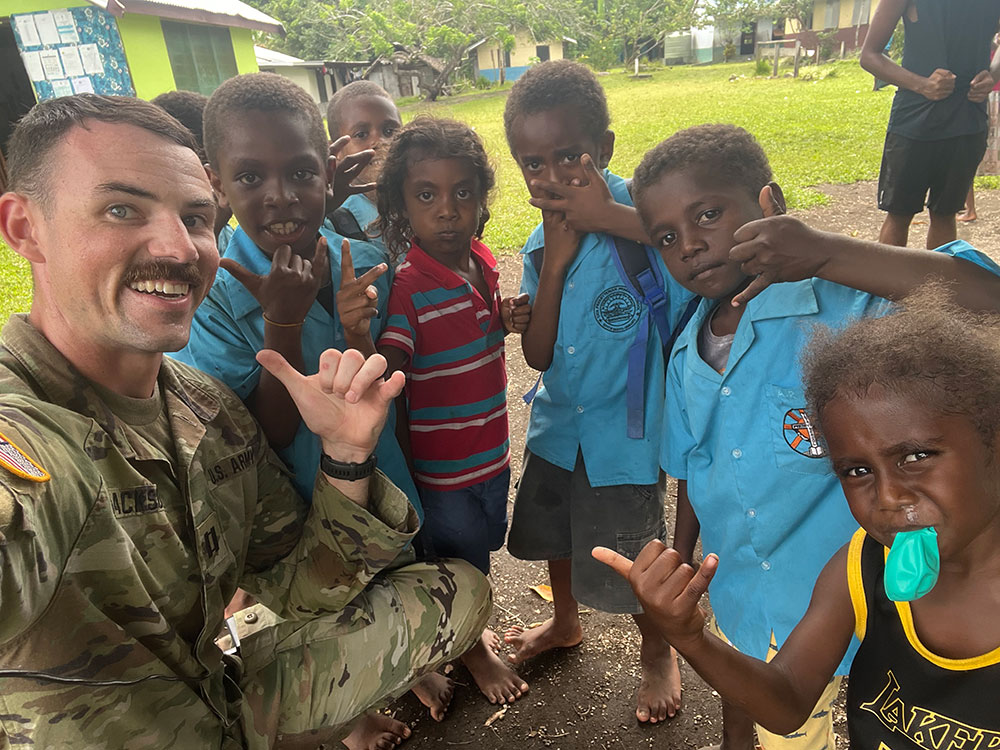
Capt. Jackson led his team in 64 veterinary engagements under the scope of animal medicine, veterinary public health and food safety, including 106 desexing (spay/neuter) surgeries, 93 livestock and companion animal appointments, 56 food safety side-by-side inspections of restaurants, markets, and commercial facilities, and 14 agricultural workshops reaching over 930 individual participants.
“It was an amazing experience to see what veterinary medicine looked like across the globe and in resource
constrained countries,” Capt. Jackson says. “It was amazing to get to work with so many fellow veterinarians from across the world! Each experience and event together with these veterinarians were able to teach me different tips, techniques and skills in approaching surgeries and other procedures.”
Capt. Hood’s Continuing Promise team also worked alongside local veterinarians, conducting surgical side-by-side operations for small animal desexing (spay/neuters). These events allowed for sharing of diff erent surgical techniques and efficiency tips.
Back at stateside
Capts. Hood and Jackson both fill similar roles for their regular duties back at their home bases.
“Both Karen and I fill the role of the Officer in Charge (OIC) of a Veterinary Service Support Team (VSST) at our home units,” Capt. Jackson says. “As the VSST OIC, we are the singular veterinarian for the team, and also the primary leader/manager for the team, consisting of approximately one to two veterinary assistants and four to six food inspectors.”
Capt. Jackson says the VSST serves as a deployable unit to provide Role 2 veterinary care and food protection assets to a division (about 10,000 to 20,000 soldiers) in a deployed environment.
“As the Role 2 providers, our medical capabilities are focused on receiving injured Military Working Dogs (MWD) after they have been evacuated from the front lines, providing medical and surgical care aimed at stabilizing the MWD prior to transferring the patient to a more definitive level of care,” Capt. Hood says. “For food safety, we provide inspections of the food shipped in and served within the area of operations, ensuring that the food and water is safe for consumption, minimizing non-battle related injuries and preserving the general fighting force.”
When not deployed, their role as the VSST OIC is leading the team in training and ensuring the team is prepared to deploy within 48-72 hours. Th is training is focused on maintaining clinical proficiency, emergency triage and stabilization and general military tactics.
“We also train and prepare both the MWD Handlers and the Combat Medics with the fighting units on what is called K9 Tactical Combat Casualty Care.” Capt. Hood says. “This is the emergency care provided at the point of injury, whether it be a gunshot wound, blast from an explosive device or other combat wounds.”
Due to the structure of the fighting units, there are no veterinary personnel assigned to the front lines with these MWDs.
“In the event of a combat casualty, the human combat medics, the MWD handler and the human medical triage teams will be providing the initial triage and care needed to keep the MWD alive to reach the Role 2 veterinary care with our VSST,” Capt. Hood says.
Capt. Jackson noted how military veterinarians can be tasked with non-combat operations, to include missions like Pacific Partnership and Continuing Promise, as well as other missions.
“I’ve had the opportunities to go on missions with the US Secret Service to the Democratic National Convention, United Nations General Assembly and the 60th Presidential Inauguration,” Capt. Jackson says. “At these events, I was the lead veterinarian for the Army team tasked to provide care and treatment to all MWDs and Federal Police K9s tasked to the support and security for the high-value attendees.”
The value of K-State connections
Capts. Hood and Jackson credit their K-State education and their contacts with the faculty with helping them complete their respective missions.
“I am constantly thankful for the veterinary community from K-State and how willing the clinicians are to help out!” Capt. Jackson says. “Th ere were multiple points that I reached out to clinicians at K-State for questions and guidance. The first time was talking with Drs. Cody Dressler and Brad Crauer during the initial mission planning, where I sought their expertise of shelter surgery to build instrument packs and take some extra pointers on surgical operations with limited resources.”
He says he also reached out to Drs. Bryan and Leslie Weaver, with Livestock Services in the Veterinary Health
Center, for consultation on some livestock and cattle medicine.
“Being able to send a quick text to ask for their expertise was a comforting feeling,” Capt. Jackson says. “It was great knowing there was always an ability to fill in any gaps or specifi c details in knowledge, especially in livestock management and clinical medicine, where I don’t have the routine practice knowledge.”
Beyond having the ability to consult with current K-State faculty, both captains agree that K-State provided a great foundation for facing the challenges of veterinary medicine in the military.
“I often consider myself fortunate to have gone to K-State for veterinary school, and this mission really reinforced that feeling as I had a strong education in cattle management, including vaccine scheduling, herd health, nutrition, reproduction, diff erent breeds and pathology,” Capt. Hood says. “I don’t practice large animal medicine on a day-today basis, but my class notes were a great resource for this mission.”
Capt. Jackson was quick to concur. “My time and education at K-State helped prepare me for the confidence and medical knowledge needed to plan, lead and execute a mission of this size.”