Ahead of the Curve
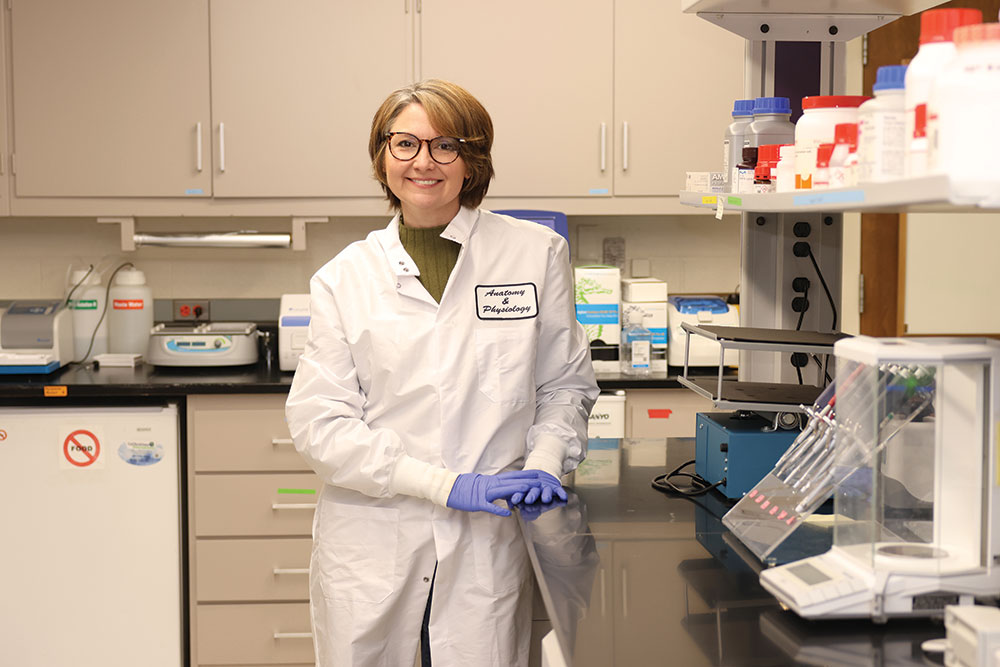
Dr. Stephanie Hall leads research efforts toward preventing Alzheimer's diesease.
By Joe Montgomery
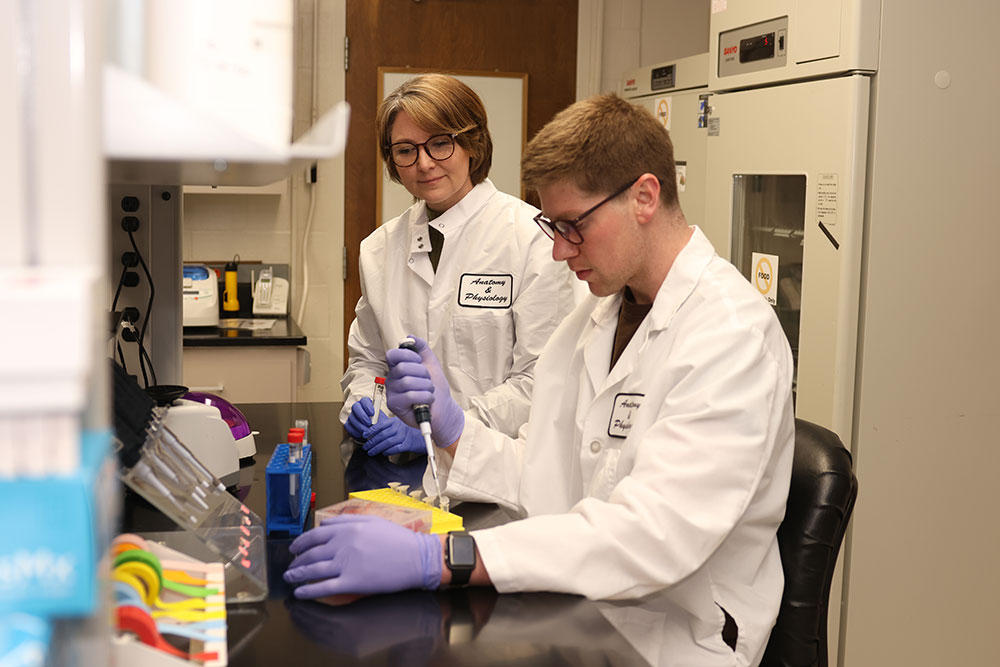
Photo caption top: Dr. Stephanie Hall, assistant professor in anatomy and physiology, discusses a research project with Zachary White, a postdoctoral trainee. Photo by Joe Montgomery.
A thought exercise.
Dr. Stephanie Hall has research on the brain.
Dr. Stephanie Hall does research on the brain.
Dr. Stephanie Hall does research on the eff ects of exercise on improving brain function.
Dr. Stephanie Hall does research on the effects of exercise on Alzheimer’s disease, or AD, a progressive brain disorder.
"While age is the greatest risk factor for AD, there are 14 identified modifiable risk factors, and modifying those risk factors could prevent or delay prevalence of AD by 50%,” Dr. Hall says. “And of those 14 modifiable risk factors, and in more than half of them, exercise has direct impacts. It reduces depression. It improves blood pressure. It improves cholesterol. So, exercise is a huge player in this area.”
As an assistant professor in the Department of Anatomy and Physiology, Dr. Hall has an extensive research background dedicated to exercise physiology and its effect on a variety of diseases that are relevant to both humans and animals.
“The pathology of AD is present as early as 20 years before symptoms,” Dr. Hall says. “It is essential to understand these early stages of AD. And exercise is one of the ways we can do that. I felt I could help contribute to this with my training and apply it to a different diesase model."
A long journey from Iowa to Kansas
Dr. Hall grew up in Blairsburg, Iowa, a town she says has less than 200 people.
“Small towns are not a strange thing to people in Kansas, but when I was doing my Ph.D. and postdoc, it was shocking to my colleagues,” Dr. Hall says. “It’s a farming community; my family grew corn and soybeans. As young as my teen ages, my focus was on exercise physiology.”
Her Ph.D. work was at the University of Northern Colorado in Greeley. And her postdoctoral work was at the University of Florida in Gainesville.
“My first faculty position was in Boise, Idaho, and then I’ve been here at K-State since 2020,” Dr. Hall says.
K-State is the first veterinary college for Dr. Hall.
“I’ve always been interested in how exercise can impact our health span and keep us healthy as we age,” Dr. Hall says. “And that, of course, spans all species. We all want our domestic pets to live as long as possible. And exercise is a great avenue to promote a healthy long health span."
Dr. Hall says her work is very mechanistic.
“We evaluate the impact of exercise, and we want to learn specifically what pathways are eliciting the positive effects,” Dr. Hall says. “In my Ph.D., I worked in a lab that studied how exercise promotes health and survivorship with cancer, which is something that definitely translates to our domestic pets as well.
Studying Alzheimer's disease at a veterinary college
“The animal model that I work with is an Alzheimer’s disease animal model,” Dr. Hall says. “Having experts who can help me give excellent care to these animals as they age is really valuable. We age our animal model to 18 months. At that age, the animals can have health effects not related AD, so it’s really helpful to have great animal care knowledge right here at my fingertips.”
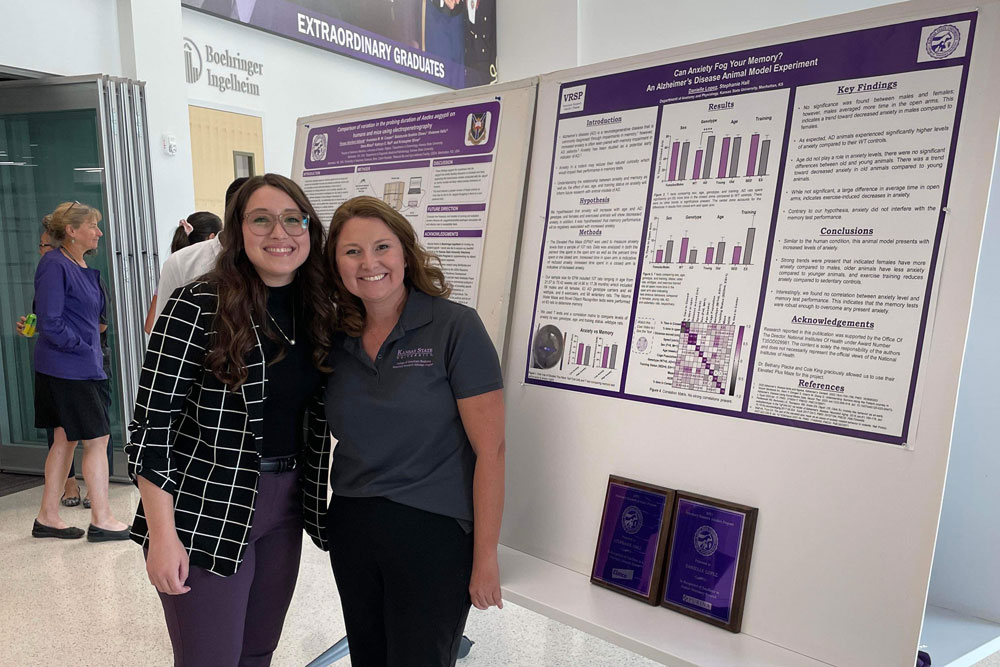
Dr. Hall works with graduate and undergraduate students in her lab. She has also participated in the K-State CVM program called Veterinary Research Scholars Program, or VRSP. This involves training DVM students in research techniques during a summer session that culminates in research posters, presentations and scholarly articles.
“Dr. Hall took the time to train me on procedures, met with me regularly to discuss what I was learning, and established checkpoints and schedules to help me reach my goals,” say Danielle Gibbs, a fourth-year veterinary student, who participated in the VRSP in the summer of 2023. She created literature reading and writing goals to help me develop essential skills for the summer and my future career.”
Danielle’s research project was titled “Anxiety in Alzheimer’s disease rats is independent of memory and impacted by genotype, age, sex, and exercise” and was published in Alzheimer’s & Dementia, the official journal of the Alzheimer’s Association.
One of Danielle’s classmates, Jessica Burger, participated in the VRSP in the summer of 2024. Her project was called “Anxiety and Alzheimer’s: An Alzheimer’s disease animal model experiment.”
“Working with Dr. Hall has been a fantastic opportunity for me to learn more about Alzheimer’s disease as well as the animal models that support the research eff ort for this disease,” Jessica says. “I also learned about the responsible use of animals in research and the important role that veterinarians play in upholding their health and welfare throughout the research process.”
Dr. Stephanie Hall says research projects have to be tailored to fit the constraints of a summer-length program and that some aspects may extend past the end of the session.
“We try to develop projects students can easily accomplish and that are really valuable for the field to know,” Dr. Hall says. “Jessica collected all of her data points, but we need to fill in other pieces so that her work can get published.”
Collaboration and future projects
Dr. Hall has served on graduate committees in K-State’s kinesiology and psychology departments. She has served as a project leader with the Cognitive and Neurobiological Approaches to Plasticity Center, or CNAP, which is an NIH-funded Center of Biomedical Research Excellence at K-State. And her biggest collaborators, of course, are within the Department of Anatomy and Physiology.
“You don’t apply for a job as a physiologist at K-State without knowing that you’re going to get some great faculty members as colleagues,” Dr. Hall says. “From day one, Drs. Tim Musch and David Poole have brought me in and fostered collaborations. And right now, Dr. Judy Delp and I are working on collecting some cerebral vascular function pilot data, which is really a hot topic right now.”
Dr. Hall seeks to understand some of the additional benefi ts of exercise.
“When skeletal muscle contracts, it releases molecules into the blood that can cross the blood brain barrier and promote new cell growth,” Dr. Hall says. “We need to identify molecules and their mechanisms of action to make the biggest impact on AD prevention and treatment.”
Dr. Hall is also examining nutritional aspects of diet as another modifi able risk factor and its long-term effect.
“We are looking at different nutritional and dietary restriction interventions and they’re showing promise,” Dr. Hall says. “What we really want to understand is why these interventions and mechanism matter, uncovering that, is genuine progress toward solving an extraordinary complex disease.”