K-State researchers receive national recognition for African swine fever vaccine research
Story by Joe Montgomery
October 26, 2026
Phi Zeta, the international honor society of veterinary medicine, presented its 2026 Research Manuscript Awards in the categories of basic sciences and clinical sciences during its annual meeting this past July. The winners included Rakshith Kumar, a K-State doctoral graduate in 2025, who took first place in the basic sciences category. His manuscript is titled "Live-vectored antigen cocktail confers protection against African swine fever virus (ASFV) Georgia 2007/1 challenge"
Winners for the two categories were each awarded $1,000 and an engraved plaque. This is the third time K-State has had a winner of this national award since 1987.
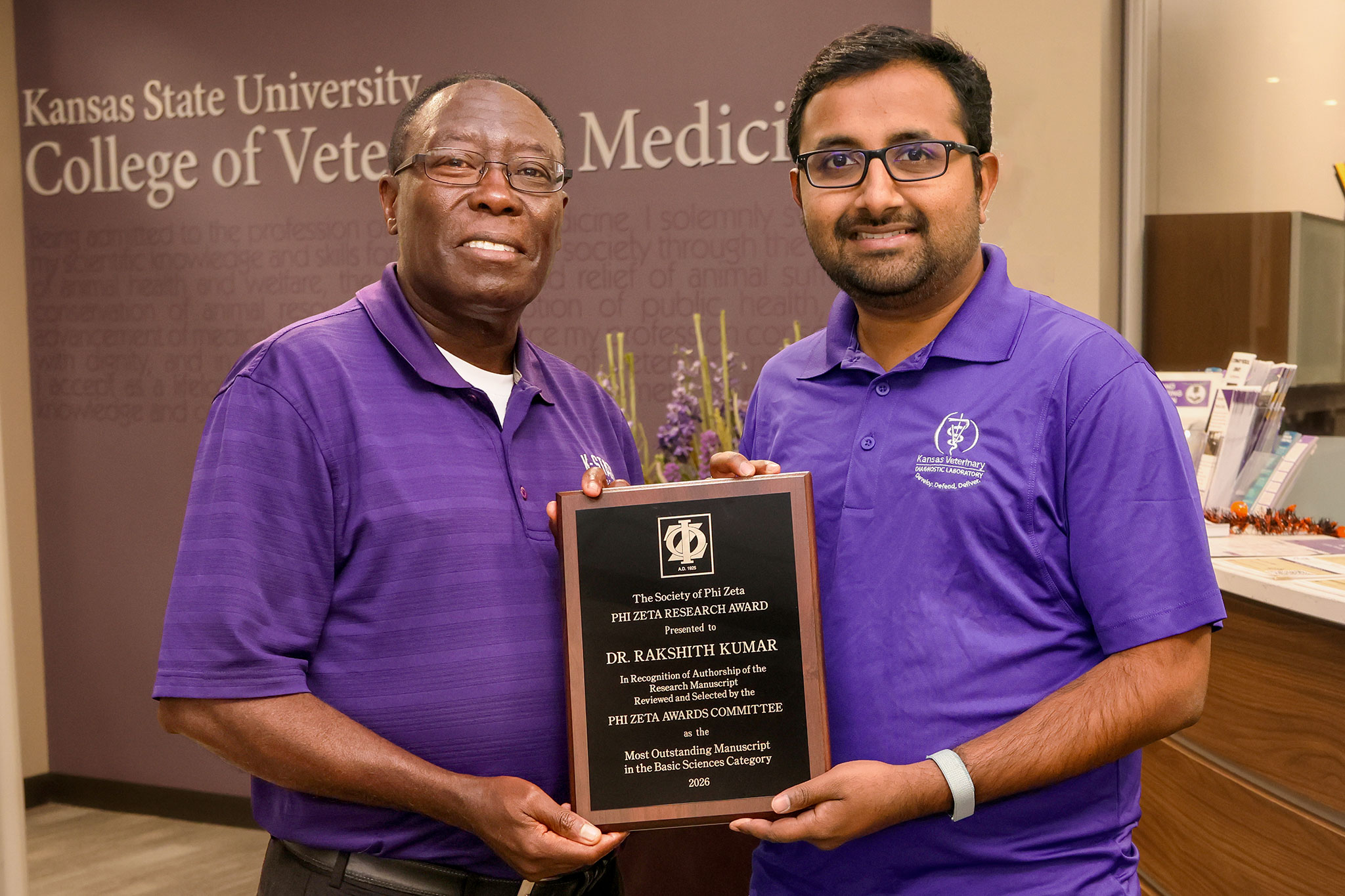
"I am very happy and grateful that our research manuscript received this national recognition," Dr. Kumar said. "I am sincerely grateful to Dr. Mwangi and our research team for their guidance and support throughout my Ph.D., and to the Sigma chapter of Phi Zeta for the opportunity to represent Kansas State University in this competition."
Dr. Rakshith Kumar is a second-year anatomic pathology resident at the Kansas Veterinary Diagnostic Laboratory. He earned a bachelor’s degree in veterinary science and animal husbandry degree from Karnataka Veterinary, Animal and Fisheries Sciences University in India, followed by a master’s degree in veterinary pathology.
Dr. Kumar subsequently completed a Ph.D. in diagnostic medicine and pathobiology at K-State in 2025, where his research focused on the development and evaluation of viral-vectored vaccines for African swine fever. He plans to pursue a career as a veterinary anatomic pathologist in academia or industry, with interests in diagnostic pathology, infectious diseases, and animal health research.
“We are extremely proud of Dr. Kumar for this prestigious national recognition,” said Dr. Waithaka Mwangi, who served as Dr. Kumar’s major professor to complete his doctoral degree. “His achievement reflects his scientific excellence and important contributions to African swine fever vaccine development. This award underscores the impact of our research on global animal health.”
The award-winning research investigated a viral-vectored vaccine approach against African swine fever, a highly consequential infectious disease affecting domestic and wild pigs, posing a major threat to the global swine industry. Their study demonstrated protective efficacy against virulent African swine fever virus challenge, highlighting the potential of this vaccine strategy.
About Phi Zeta
The objectives of the Society of Phi Zeta are to recognize and promote scholarship and research in matters pertaining to the welfare and diseases of animals. As a guide, the Phi Zeta awards committee uses the NIH definition of clinical research as applied to animal research that is patient-oriented and thus involves animals (or tissues of animal origin, but not tissues that cannot be linked to a living animal, such as in vitro studies. Clinical research includes clinical trials, epidemiologic studies and studies that focus on the mechanisms of disease, and studies that focus on diagnostic or therapeutic interventions.
###
For more information about the Kansas State University College of Veterinary Medicine, please visit our website at vet.k-state.edu or follow us on Facebook, Instagram, and X.