Frontier Field Trip connects students with Kansas history, agriculture and community perspectives
Story by Rylee Coy
June 11, 2026
During the 47th Frontier Field Trip, a group of seven students traveled to several locations in and around Hope and Abilene, Kansas, at the end of March to explore topics related to agriculture, history and community development. Dr. Justin Kastner, professor in Diagnostic Medicine and Pathobiology, served as the leader and host the learning activities on the trip.
“My favorite part of traveling alongside other students was sharing the knowledge we learned on the trip,” said Kenna Hiebert, a Master of Public Health student with in an emphasis in infectious diseases and zoonoses. “Everyone was researching different things at the (Eisenhower Presidential) library, and when we would leave for lunch or back to the hotel, we would talk about everything that we had learned while conducting research. It was fun seeing what everyone else was interested in and hearing them tell me about it!”
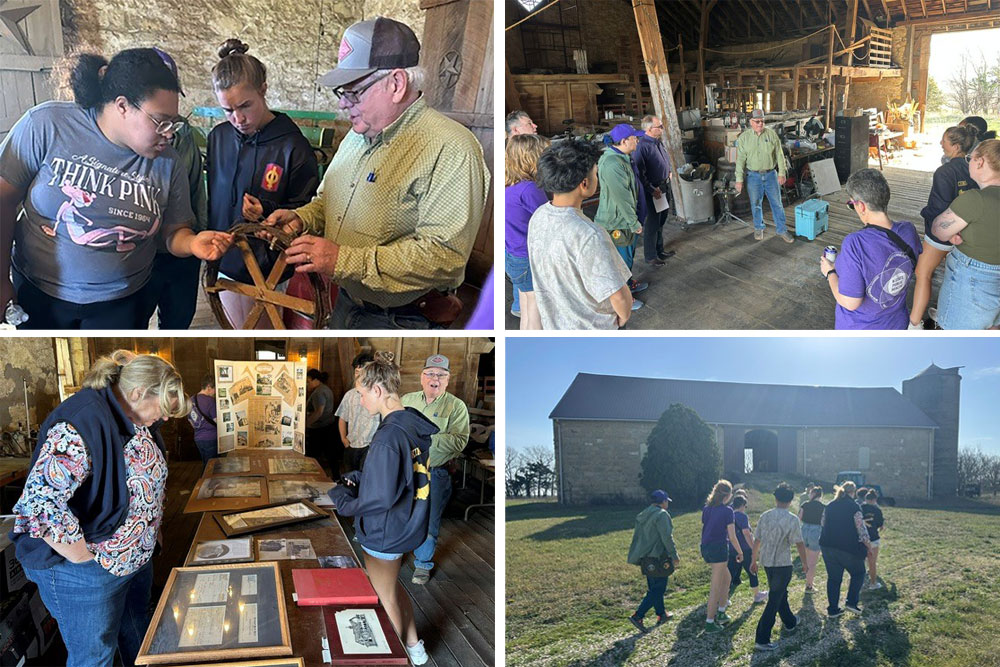
The first stop on Monday, March 30, was the Prospect Park Farm Historic Complex, the site of John H. Taylor’s historic wheat and livestock operation near Chapman. The tour was facilitated by property owner Dale Anders. The group then visited the Herington Reservoir, where Brian Lang, an official with the Lyons Creek Watershed, discussed watershed management and regional water conservation efforts.
Students later participated in a lunch-and-learn session at Agri Trails Coop, facilitated by Darel Anderson and colleagues. Discussions focused on protecting the food supply, grain marketing and reducing agricultural inputs while continuing to feed a growing global population.
“I really enjoyed learning about how farming has evolved over the last 30-40 years regarding pest and drought management,”said Kelli Shoemaker, a Master of Public Health student with an emphasis in food safety and biosecurity. “What really resonated with me was how agriculture, just like animal and human healthcare, has had to evolve and pivot in response to changes in the environment, costs, and technology. A lot of research is done every year to decide which types of seed the coop should purchase, how much to purchase, the total costs, and the farmers' interests.”
Kelli also learned about how Agri Trails Coop support farmers with decision making in the ever-changing agricultural landscape.
“They spend a lot of time working with each farmer to ensure that the seed they purchase is the best fit for their farms and local environment,” Kelli said. “Since it's a farmer-owned business, the farmers themselves have a stake in how well the coop performs and how well it supports them and their neighboring farms. This, in turn, leads to greater local support and strengthening of communities.”
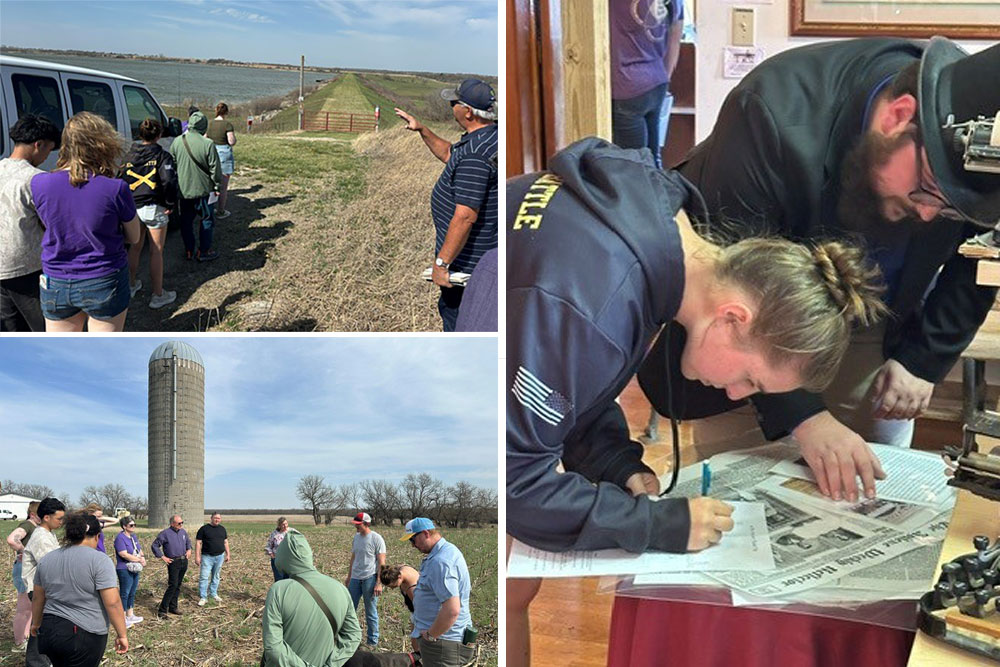
Following the lunch session, the group visited the Hope Community Museum. Exhibits highlighted the Hope milk condensary plant, the Hope Stucco Company mines and United States Gypsum operations, military history and the David Eisenhower general store.
Before continuing to Abilene, the group made its final stop of the day at the Nature Conservancy Terrace Lane Farm. There, students learned about the Pray family history, regenerative agriculture practices and conservation efforts from Chance Jacobson and Chris Janssen.
After the day’s visits concluded, the group traveled to the Victorian Inn for dinner and closing remarks from Dave Rock, '80, '03 who helped plan this trip.
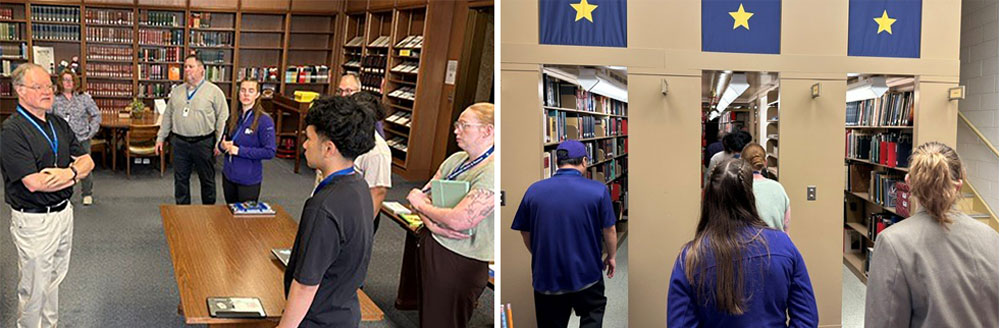
On Tuesday, March 31, students spent the morning at the Eisenhower Presidential Library conducting archival research under the guidance of Dr. Jim Ginther, supervisory archivist at the National Archives and Records Administration. During 90-minute work sessions led by Dr. Justin Kastner, students read historical materials, documented observations and reflected on their findings.
"Conducting archival research at the Eisenhower Presidential Library was a very unique and meaningful experience for me,” said Lei Zhong, an undergraduate student studying grain science and industry. “It was my first time working directly with historical materials that carried real traces of the past. I saw many handwritten letters, original archival documents, and even handwritten notes made by clerks decades ago. Some collections also included old photographs, vintage advertisements, and other visual materials. It truly felt like I was having a conversation with people from history.”
Before returning to Manhattan, the group completed a self-guided tour of the Eisenhower Museum.
Thinking more about the Frontier Field Trip, Lei reflected on the immersive nature of the Frontier Field Trip and the opportunity to learn through both archival research and community interaction.
“What made this program especially valuable was that it was not limited to reading documents in a library,” Lei said. “In addition to archival research, we visited farms, talked with local farmers, scholars and museum professionals, and learned through their personal stories and experiences. The project felt very multidimensional and immersive rather than simply academic or textbook based.”
Lei also emphasized the value of engaging with peers from different academic backgrounds throughout the experience.
“Everyone approached the same topics from different perspectives, which really broadened my thinking and deepened my understanding of the world,” Lei said. “Those conversations were incredibly valuable to me.”
About Frontier Field Trips
The Frontier Field Trip program was started by Dr. Kastner and Dr. Jason Ackleson in 2007 to provide scholars with the opportunity to explore disciplines outside of their own. This program has been in place for nearly 20 years. The field trips are immersive and interactive to help students look at different career opportunities and let them connect with other students outside of their academic disciplines.
For more information about the Frontier Field Trips, please contact Dr. Kastner at jkastner@k-state.edu.
###
For more information about the Kansas State University College of Veterinary Medicine, please visit our website at vet.k-state.edu or follow us on Facebook, Instagram, and X.