Dr. Konnor Stueve dissects anatomy education to reach advanced learners
Story by Joe Montgomery
Photos by Rylee Coy and Joe Montgomery
One of the newest faculty members in the College of Veterinary Medicine found a unique way to fit his passion into a career opportunity. Through resourcefulness and adaptability, Dr. Konnor Stueve, clinical assistant professor, has essentially blazed a new trail in veterinary anatomy education at Kansas State University.
Finding his passion
“When I went into veterinary school at the University of Minnesota, I totally thought small animal general practice was going to be what I was going to end up doing,” Dr. Stueve said. “But while going through the curriculum, it wasn't that I didn't enjoy it, but I struggled to find my passion within veterinary medicine. I knew that veterinary medicine was what I wanted to do, I just didn’t know what aspect of veterinary medicine yet. I wasn’t sure anymore if small animal general practice was what I wanted or if I maybe wanted to try to specialize in a certain field.
Dr. Stueve said he began questioning his long-term goals.
“That led me to reach out to practically every single faculty member at Minnesota and ask, ‘What all can I do with the DVM?’” Dr. Stueve said. “And the conversations always steered toward things like, ‘What classes did you really enjoy in the curriculum?’ And every single time, the answer was always anatomy.”
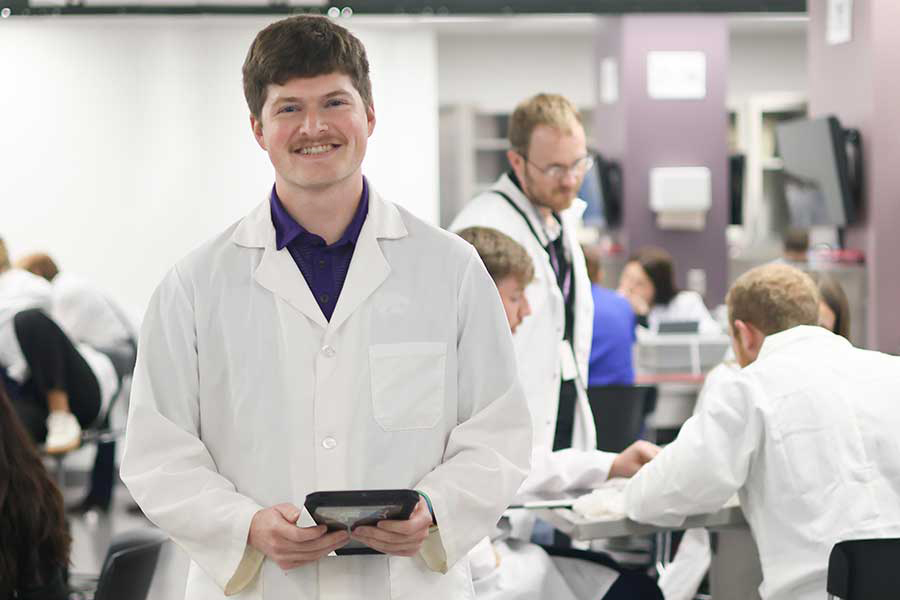
Dr. Konnor Stueve graduated from the University of Minnesota in 2025. He spent four weeks at Kansas State University during his senior year to fulfill clinical rotations in anatomy instruction. This experience opened the door for Dr. Stueve to return as a full-time faculty member.
Dr. Stueve said it wasn't necessarily from the DVM anatomy course, but a brief anatomy course in high school and a basic undergraduate anatomy class in college that his passion originally developed.
“I had to take anatomy for my prerequisites for veterinary school and I really enjoyed it,” Dr. Stueve said. “I especially enjoyed the dissection portion of the veterinary school’s anatomy.”
Finding a path forward
“There's a shortage of anatomists — especially trained anatomists — specifically for veterinary anatomy,” said Dr. Pradeep Malreddy, clinical associate professor in the Department of Anatomy and Physiology (A&P). “With all these [new veterinary] schools opening up, there is a lot of demand for someone who is trained specifically in anatomy education. It happens some on the human side of anatomy instruction, but not in veterinary anatomy that I’m aware of.”
The question for Dr. Stueve became how to merge his passion with a proper course of training toward becoming an anatomist.
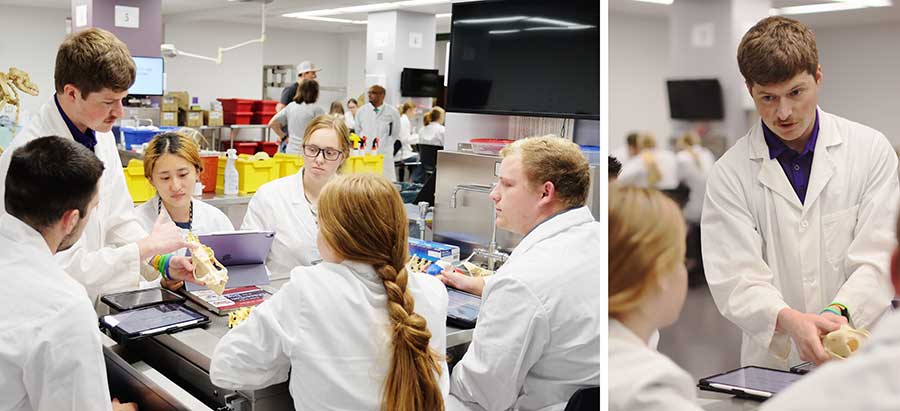
Dr. Stueve points out different structures on bones in first-year anatomy class.
“Minnesota runs the fourth-year curriculum differently than here at K-State,” Dr. Stueve said. “Minnesota is a tracking school. What that means is before you begin the fourth-year curriculum, you have to select a track to follow, within each track are core rotations that need to be taken to successfully graduate, and most of these rotations reflect around the specific track you select. Examples of the tracks offered are small animal, production animal, equine, mixed animal and research. I was talking with our faculty to figure out which one of those tracks I would fall under. It’s a very challenging thought, because the anatomy curriculum truly falls under all of those tracks.”
Dr. Stueve said it was believed that the research track would most closely fit with what he wanted to do, but then, he said, “It didn’t really work.” He had several committee meetings to talk about tailoring a curriculum that would work.
“After several petitions to the curriculum committee, my fourth-year research track plan was approved and in doing so, I became the first student from the University of Minnesota College of Veterinary Medicine to use fourth year rotations for pedagogy,” Dr. Stueve said.
Dr. Stueve spent the entire fall 2024 semester at Minnesota teaching veterinary anatomy in-house in place of typical clinical rotations.
“And then in the spring semester, I reached out to several other vet schools to see if I could spend a rotation in their veterinary anatomy labs,” Dr. Stueve said. “I did four weeks of anatomy teaching at North Carolina State University, four weeks at Michigan State University, and four weeks at Kansas State University doing the exact same thing. I've been in the anatomy lab helping teach the laboratory sessions, attending lectures, assisting with on-going research projects and attended faculty meetings to better learn how to be an effective educator. And at K-State, I got the opportunity to give a lecture while I was here.”
Finding new opportunities for teaching
After Dr. Stueve completed his DVM, he received an opportunity to return to K-State as a full-time faculty member.
“I finished my rotation with K-State in mid-April this year, about a month before graduation,” Dr. Stueve said. “Before I left to return to Minnesota to finish my last hospital rotations, Dr. Mike Apley [A&P department head] took the time to meet with me and had mentioned that an opening was coming up here at K-State and that I should keep them in mind.”
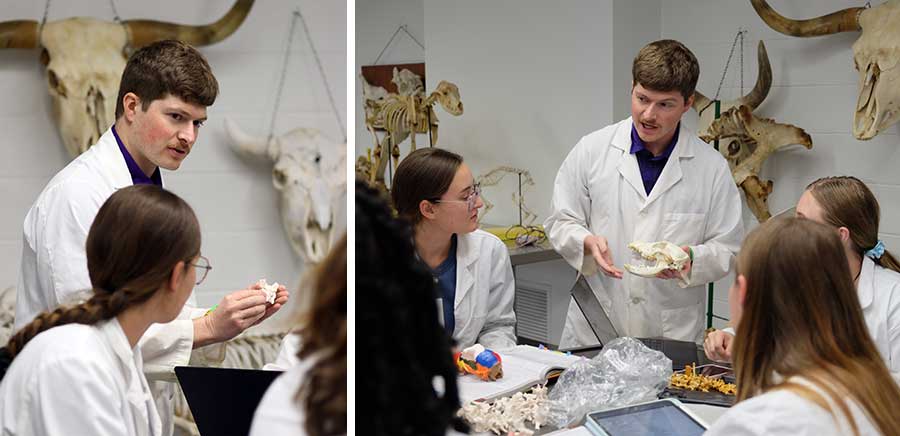
Dr. Stueve answer questions at one of the anatomy stations. Veterinary students are required to take anatomy courses during the first year of DVM studies.
Shortly after he graduated, Dr. Stueve was back in Manhattan interviewing for the position.
“What really drew me in and what really made the decision easy to come here [to K-State] was the anatomy team itself,” Dr. Stueve said. “It felt like a group that was just very easy to fit in with and, right from the jump, feel like a part of the team. Here, I would be able to not only immediately step into an active role but also learn from many outstanding anatomists.”
“We are grateful to have attracted Dr. Stueve here to join our anatomy team," Dr. Apley said. "He is already a hit with our first-year students. There is nothing better than having a person join us who is so enthusiastic about their subject area, which it turns out is contagious to both students and faculty.”
Dr. Malreddy said that hiring Dr. Stueve has created an opportunity for a new course in anatomy.
“When our previous department, Dr. Hans Coetzee [now K-State vice president for research] was here, he was always encouraging us to try to do new things, and saying that we should have more involvement with fourth-year students,” Dr. Malreddy said. “That's when we began thinking of starting an elective rotation where the fourth-year students could take clinical anatomy that could be applied for other disciplines. For example, for any students who want to do advanced surgeries, emergency medicine, neurology or equine surgery — a clinical anatomy elective could work very well to support those rotations or to supplement the education of students with those types of specialized interests.”
Dr. Malreddy said the new elective course will be offered for the class of 2027 during its fourth year of studies.
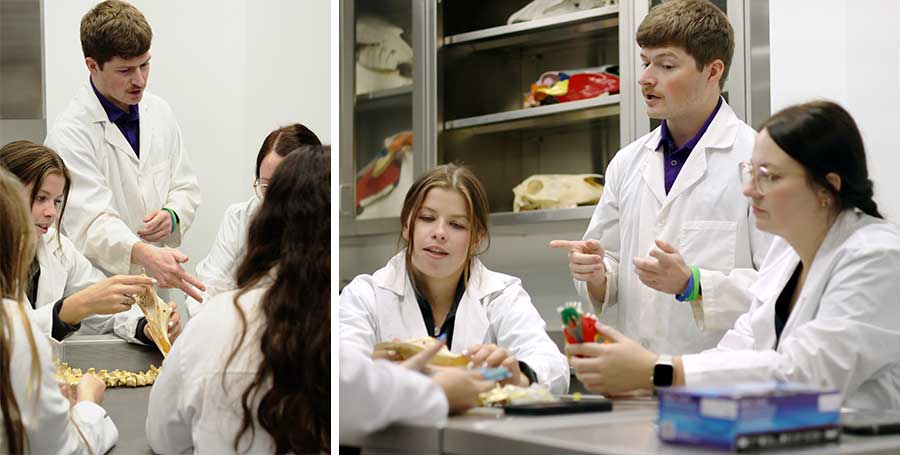
Dr. Stueve leads students through recognition of teeth and dental structures with bovine skulls. He will be responsible for teaching a new clinical anatomy course to fourth-year students beginning in fall 2026.
“Traditionally, when we teach anatomy, we tell students to know every single muscle, every single blood vessel,” Dr. Malreddy said. “With the clinical anatomy elective, we will go in much more detail and teach them what they would utilize in their clinical, day-to-day practice. This would help them can focus on things such as surgeries and other advanced procedures.”
Dr. Stueve said he’s enjoying his work with first-year students in the anatomy laboratory and that he looks forward to the next school year when he can add his new responsibilities in teaching clinical anatomy to fourth-year students.
“If they want to understand more about the anatomical locations of things such as abdominal organs and which surgical approaches are best to access these locations, then in this new class we can go in depth and explore how structures will appear from this view,” Dr. Stueve said. “I want them to get that better understanding, so they can perform better in their surgical rotations or other rotations, and maybe give them an advantage when they apply for advanced training opportunities or step out into clinical practice.”
Through this new option and their own adaptability, future DVM students, like Dr. Stueve, might be able to blaze their own trails to exciting, new untapped careers in veterinary medicine.
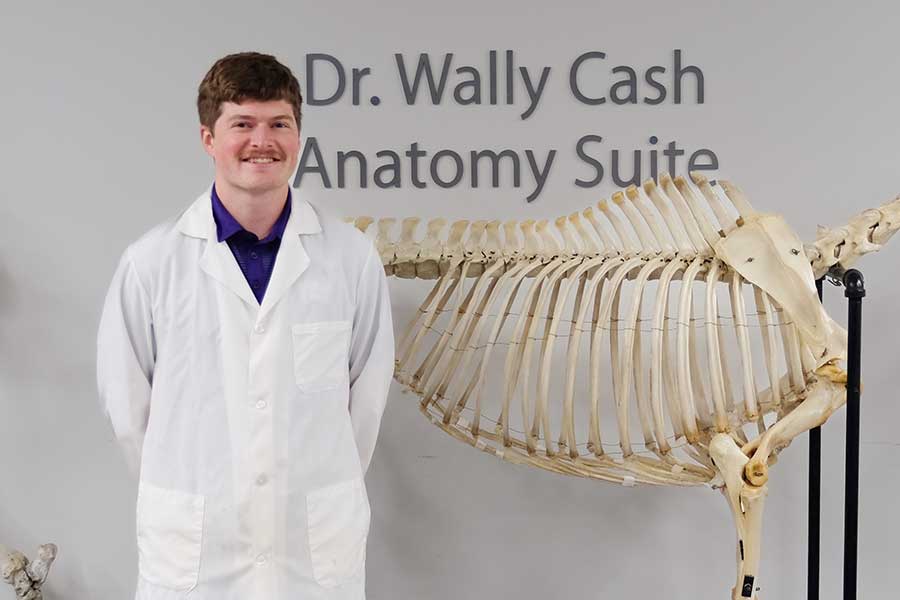
Dr. Stueve teaches in the Dr. Wally Cash Anatomy Suite, named after a popular instructor and alumnus.
###
For more information about the Kansas State University College of Veterinary Medicine, please visit our website at vet.k-state.edu or follow us on Facebook, Instagram, and X.