K-State students participate in 45th Frontier Field Trip to Victoria and Hays
Prepared by Frontier Field Trip participants Torre Dunlea, Alexa Heseltine and Madeleine Pike
In early October, Dr. Sandy Philip-Sprague and Mike Sprague graciously welcomed students from Kansas State University and Fort Hays State University to their historic homestead for an educational visit exploring the legacy of George Grant and the founding of the Victoria Colony. The students were participants in the 45th Frontier Field Trip led by Dr. Justin Kastner, Frontier director and professor of food safety, with the opportunity to delve into an important era in Kansas and American agricultural history.
The setting was 1872, when Scottish nobleman George Grant set sail for the United States with hopes of investing in agriculture. Upon arriving, Grant fell in love with the vast prairies of Kansas. He and 18 English colonists established the community of Victoria, Kansas. George and his wife purchased land nearby and began preparations to build their own homestead — which stands today near Hays, Kansas. Although many of the British settlers eventually left Kansas due to the region’s harsh climate, this colony endured after German immigrants settled the area, bringing with them a resilience suited to Kansas’s cold winds and open plains.
George Grant’s legacy continues to this day. He is remembered as the enterprising pioneer who introduced Angus cattle to America, eventually revolutionizing the country’s beef industry. Descendants of his fellow settlers, including the Philip family, proudly continue to operate in the immediate vicinity of the original Grant Ranch and homestead, preserving both the land and its remarkable history.
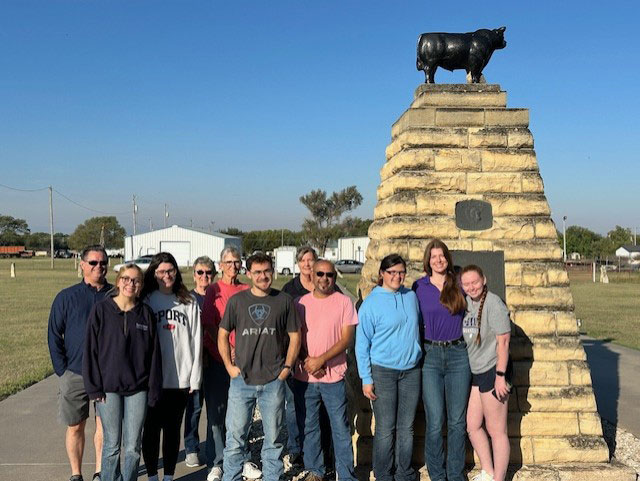
Frontier students from left: Hays native George Rifford, KSU student Maddie Pike, KSU student Alexa Heseltine, KayLynn Philip, Dr. Sandy Philip-Sprague, KSU student Ethan Summervill, FHSU professor Dr. Brittany Howell, FHSU student David Uresti, FHSU student Grace Johns, KSU student Torre Dunlea, and KSU student Kenna Hiebert.
Day 1 — Oct. 9
The caravan stopped in Victoria to catch a glimpse of the St. Fidelis Basilica, guided by George Rifford, a colleague of Dr. Kastner and a descendant of those who helped establish the Basilica. After the brief stop, the group continued into Hays to become acquainted with the antique homes where they would spend the night in nostalgic properties called “Buffalo Haus” and the “Midmod on Sixth,” embracing the history of the community.
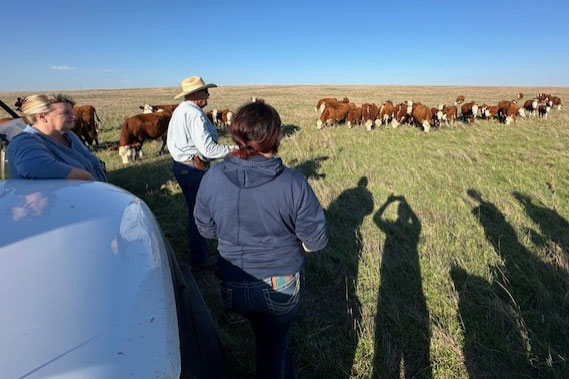
The K-State group met up with students and faculty from Fort Hays State University, or FHSU, and departed for the Philip Ranch. On the way into the ranch, the group stopped in one of the cattle fields and were lucky enough to meet Mike Sprague and his grandchildren.
Sprague gave the students a historical overview of his Hereford cattle before everyone headed back to the Philip Ranch. After a delicious meal shared over introductions, Dr. Phillip-Sprague gave an inspiring overview and tour of the ranch, including a chance for the students to interact with family documents, photos and memorabilia. As part of the evening, Dr. Brittany Howell, professor at FHSU, delivered a talk on 19th century animal-breed introductions (some connected to the Victoria colony).
Frontier field trip participants at Philip Ranch.
Day 2 — Oct. 10
Day two of the field trip deepened students’ understanding of the people, ideas and challenges that shaped 19th-century agriculture in western Kansas. The day began at the George Grant Memorial, where Dr. Kastner highlighted the intertwined themes of innovation, investment and immigration in U.S. agricultural development. Drawing from archival documents he encountered during his own research, Dr. Kastner helped students better understand the cultural overlap and community dynamics that emerged in Victoria, Kansas.
Following this session, the group drove a short distance to the George Grant Villa, where the current homeowners graciously welcomed the students into the historic property. Scholars gained a firsthand perspective on the daily life that the original settlers of the Grant and Philip ranches likely faced; this involved closely examining the limestone fence posts carved from nearby riverbanks. The intricacy and durability of this work highlighted the resourcefulness and craftsmanship that settlers brought to the region.
Dr. Howell emphasized the topics of hardship and health during frontier settlement, including environmental pressures such as invasive pests. At lunch, the students were entertained by theatrically skilled re-enactor Adam Conkey, who portrayed George Grant. He brought to life the experience of settlement, raising livestock and building communities. “Mr. Grant” also ate lunch with the students and shared his interest in the innovation of putting pineapple on pizza — something he highly appreciated!
Collectively, these experiences enriched K-State and FHSU students’ appreciation of Kansas history while demonstrating the value of interdisciplinary engagement. Through historical interpretation, site visits and dialogue with scholars, students were encouraged to reflect not only on how agriculture has evolved, but also on how community, innovation and resilience continue to shape our food system today.
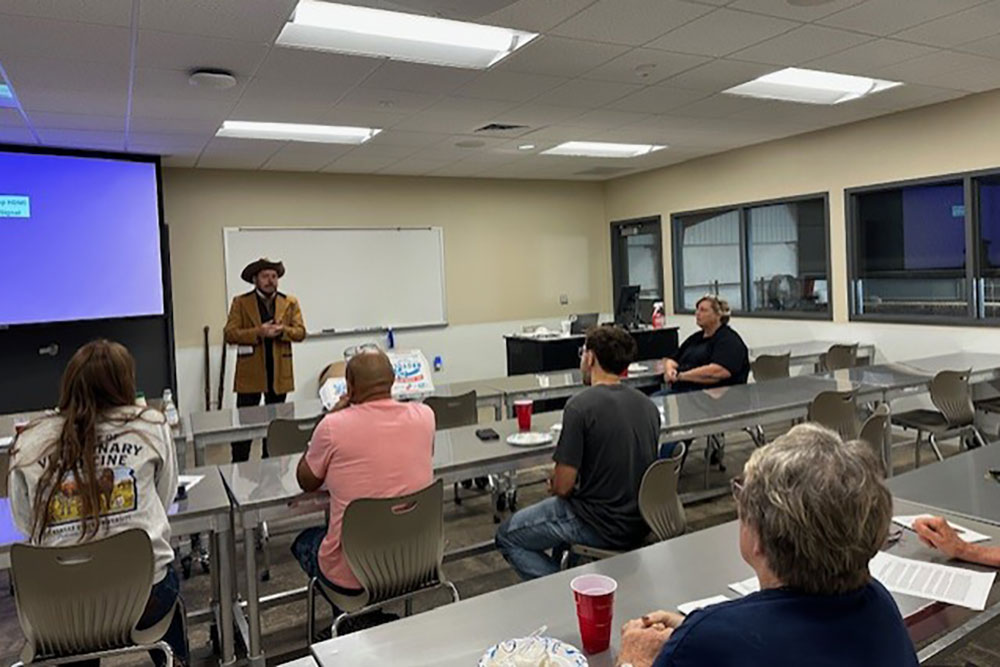 Frontier participants meet Ellis County settler George Grant as reenacted by Adam Conkey.
About Frontier Field Trips
The Frontier Field Trip program was started by Dr. Kastner and Dr. Jason Ackleson in 2007 to provide scholars with the opportunity to explore disciplines outside of their own. The field trips are immersive and interactive to help students look at different career opportunities and let them connect with other students outside of their academic disciplines.
For more information about the Frontier Field Trips, please contact Dr. Kastner at jkastner@k-state.edu.